Monday, 6 October 2014

Flowers of the African veld.

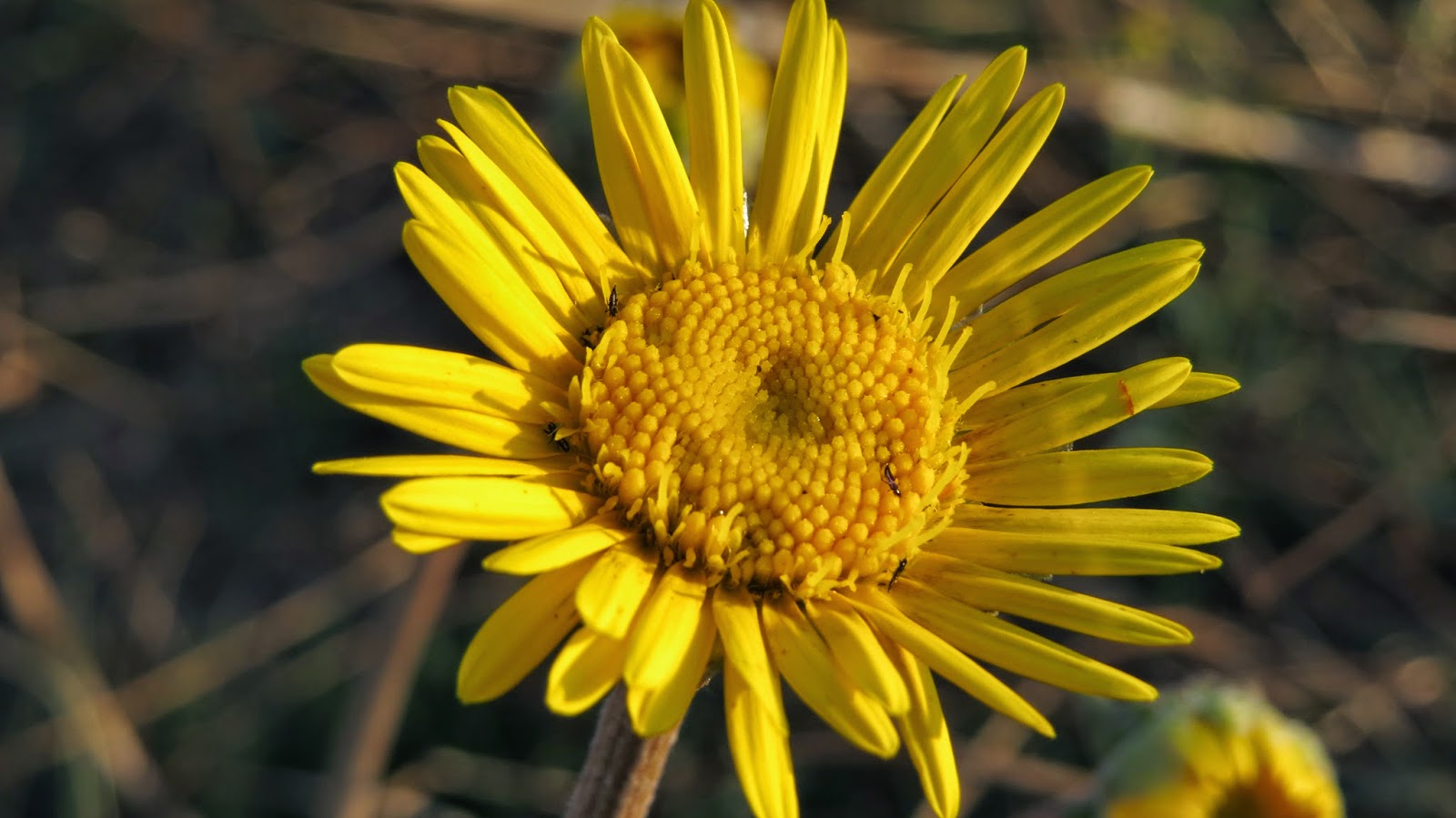
Most of the flowers shown are so small as to be hardly noticeable, but when knows where to look treasures are revealed. One can spend hours photographing them, you find one then you see another and another.

Almost every flower has it's insect life and if the flowers are small the insects are minute.

All these photos were taken down on my knees with the camera lens millimeters from the flowers with the camera set on macro mode. Late afternoon or early morning is the best time for this kind of photography.

Click to enlarge.


Delicate perfection.


The grass stems around this flower gives you an idea of just how small it is.


Lacy yellow. This flower has an insect visitor a tiny beetle, look bottom left.


This delicate flower is tiny, yet on the bottom left there is an insect that is tinier still.


I cropped the rest of the photo above so that it is easy to see the insect.


When it comes to small this one wins first prize, on the left is a bud about to open, and there will be an even tinier insect to pollinate it.


A delicate bouquet in mauve.


Last rays of the setting sun shining through the petals of this flower, enlarge this photo and look closely, you will see a speck of an insect.


Delicate grass seeds back-lit by the setting sun.


Focused. My friend and fellow teacher, a k a the Italian Leprechaun, trying for similar shot as the one above. 


Saturday, 4 October 2014

Addo National Elephant Park.

After my last post I looked up some info on the Addo National Elephant Park and found it's official web site.

www.sanparks.org/parks/addo.

Be sure to watch the video.

Addo elephant rescue.

Addo National Elephant Park is situated in the Eastern Cape province near the city of Port Elizabeth. Here in South Africa when we talk of Port Elizabeth we just say PE.

I got this story and the photos by email from a friend.

In the photos below you will see adult elephants trying to rescue a baby elephant which had fallen into a water hole and could not get out.


You can see the baby just under the head of the young elephant in the water.


Addo park rangers brought a backhoe to try and make a slope in the vertical banks of the water hole so that the baby could climb out. The adult elephants became very agitated at the sight of this big machine and would not let them near the baby.


The rangers managed to drive off the adults so that they could help the baby.


Two rangers jumped off their pickup truck and ran to help the baby. Mother elephants are very protective of their babies, so what they were doing was extremely dangerous.


Baby elephants are very heavy but they managed between the two of them to lift the baby onto the bank.


Other rangers came running to help.


The rangers ran off to get back on the pickup and out of moms way, but baby had other ideas and ran after them.


Mom could not see her baby because of trees and bush in the way so the ranger put baby on the truck and drove to an opening where she could see her baby and put it on the ground.


Baby still wanted to go with it's new found friends so mom had to chase after it.


Relieved mom and her baby together at last. The little elephant had been trapped in the waterhole for 3 hours. This rescue took place on the 27th of August 2014.

Never approach a wild elephant, never ever get between elephants and their young! If you should see any wild animal in trouble contact the park rangers as this photographer did. 

As they say in the classics, "don't try this at home".

The history of Addo Elephant Park and it's elephants is a very interesting one, I will do a post on it soon.

Thursday, 2 October 2014

Fibonacci spiral, Fibonacci numbers and the golden mean.

What I'm about write about might make me seem to be an expert mathematician, well don't be fooled, I'm not! My teachers never thought so. I can do arithmetic, plain old adding, subtracting, dividing and multiplying, but not the other fancy stuff, just never got it. All the information I've used can be found on the internet.

When you start photographing really tiny flowers, you have to get real close, down on your hands and knees, (getting down is the easy part) these close-up photos reveal things you would not usually see. You see intricate design! 

Click to enlarge.


Look carefully at the florets in this flower and see the spirals, these spirals are known Fibonacci spiral, and you find them everywhere in nature. If you enlarge this photo you will see the minute insects that call it home. Why were these tiny flowers, which most people would never see, made so perfect and beautiful? And with most of them it's literally here today gone tomorrow. 


This illustration that I downloaded from the internet, shows clearly how these spirals look. The numbers 21 and 34 are known as Fibonacci numbers. A daisy for instance has 34 petals, I haven't counted them personally.

Fibonacci number sequence: 1, 1, 2, 3, 5, 8,13, 21, 34, 55, 89, 144,... .


Another Fibonacci number is the number five, count the stamens on these tiny flowers, (the camera lens was millimeters away from the flower) there are five on each one. This delicate little flower brings to my mind a ballerina dancing.


Every one of these tiny flowers has five petals.


Drawing of a Fibonacci spiral. The rectangle within which the spiral fits is called the "golden mean".


Fibonacci spiral in a spiral galaxy.


In a nautilus shell.


In a hurricane.


The Parthenon in Athens Greece is the most famous man-made examples of the "golden mean".

Who or what was Fibonacci? Leonardo Fibonacci (1170 - 1240), was a mathematician, the most renowned mathematician of his day, who lived in Pisa Italy. 

Sunday, 28 September 2014

First rain of summer.

Yesterday afternoon it started to rain softly, it rain softly for most of the night it has been raining all of today.

Click to enlarge.


When I looked out my front door this morning I saw this rose and rosebuds sprinkled with rain drops.


This opening rose looks almost like a strawberry, good enough to eat. 

It's been a long dry summer, this is the first rain since May.

Sunday, 14 September 2014

First fish of summer.

Bass fishing in South Africa usually takes in the summer, that is all the month's that have and "r" in them.

Took a #6 fly rod down to one of the farm ponds and tried my luck, well first cast and I caught a nice small-mouthed bass. These bass are real fighters and give you a good run for your money.

Click to enlarge.


+/- 2 lbs.


Same fish, photo by Enrico Bucceri, a.k.a., the Italian Leprechaun. The following photos were all taken by Enrico.


I look a bit startled here, but this photo gives a nice idea of the size of the fish.


Tombi watching me cast. I think I have mentioned it before, Tombi means young girl in Zulu. Not so young any more +/- 14 years old now.


 Strike!


Second bass, small but gave a good account of itself.


Third fish, slightly bigger than the second. I caught four fish and missed several, think the hook was a bit blunt. 

My fly was a large "woolly bugger".

Saturday, 13 September 2014

Grandfather & grandson.

My landlord, Owen and wife Sue are looking after their grandson Ben, the son of their daughter who lives in Durban. 

Click to enlarge.


I love my granddad. 

Owen Moore and his grandson Ben on granddad's modern steed. The first words that Ben learn't to say are ganda-ganda, Zulu for tractor. 

A real son of the soil, and a humble man with a deep Christian faith. Owen is supposedly retired and his son is farming now, but Owen is up at sunrise and still going at sunset.

Owens great-grandfather was Sir Frederick Robert Moor, 1853 - 1927, the last Prime Minister on the Natal colony, from 1906 - 1910. In 1910 Natal colony, Cape colony and the two ex Boer republics of the Orange Freestate and the Traansvaal, (Zuid Afrikaanse Republiek), amalgamated to form the then Union of South Africa, which became the Republic of South Africa in 1961.

Sir Frederick Owen Moor was a member of the Natal legislature from 1886 - 1910, Prime minister from 1906 - 1910. A minister in the first Union cabinet under General Louis Botha and the senator in the Union senate from 1910 until his death in 1927, he was also a member of King Edward VII's privy council.

Strange how people who really have "it" never flaunt it, I had to search for the above information on the internet. Owen's son Dave seems to have inherited his great-great grandfathers drive, apart from owning two farms he manages several businesses at the same time, not interested in politics though.