Without the resurrection the cross would have no meaning.
This cross was put up by one of our local businessmen on a hill at the southern entrance to Estcourt. At night it can be seen from miles around.
This photo was taken on Good Friday from the grounds of our church, the cross is about 3km away
Land of mountains, trout streams and wild brown trout.
After paying the entrance fee and for a fishing permit we drove about 2km further to the first camp site. I put on my neoprene booties and wading boots, we both grabbed our back packs, mine with my 2 weight rod in it, and we were off to the water. The descent to the water was pretty steep but we made it down without mishap.
I quickly set up my rod, threaded the line and tied on a size 14 *RAB on 4x leader with a 5x tippet. Without wasting time I waded in, the water was cool, but pleasantly so. The Italian leprechaun was appointed official expedition photographer and he wasted no time taking photos.
Click on pictures to enlarge.
The first pool that I fished.
Third or fourth cast I was rewarded with this nice wild brown trout, small but beautiful. A perfect specimen of a wild fish. A great thrill to catch a fish with a rod you built and a fly you tied. The largest fish I've heard of caught in this stream was 6lb +, but that was much further downstream where the stream is much wider and deeper.
Brown trout were released into the Loteni river more than a hundred years ago, since then they have bred and thrived in this stream in spite of extreme heat, cold, floods and periodic drought.
After this I decided to move downstream about 500 metres and fish my way back upstream.
Deciding which fly; decision, a parachute Adams. I had completely forgotten about the Italian leprechaun with the camera so I was totally unaware of him taking photos.
Tying it on, sometimes a tricky business.
Fish on. Only for a second or two though, and it became one of several long distance releases of the day.
In spite of catching only catching one fish, missing many and losing several, it was still a great day. After four hours on the river we called it a day.
*RAB, a South African dry fly in the variant style.
Land of mountains, trout streams, water falls and birds.
After about 3 travelling we finally turned onto the road leading into the Loteni Nature Reserve. The first part of the road goes through Zulu tribal and with beautiful stretches of the Loteni river flowing alongside. Every bit looked like it could hold nice fish. To fish here one would need to get permission from the local Induna (Chief), and he might live miles from here.
Click on photos to enlarge.
Bridge crossing the Loteni river, looking upstream. This photo was taken as we were leaving. Photo credit Enrico Bucceri.
Looking downstream from the bridge.
The first bird we saw on entering the park was this Jackal buzzard, (Buteo rufofuscus).Preferred habitat mountainous country up to 3,000 metres. Prey; small mammals up to the size of a hare, it will also take lizards, frogs and insects. Name is a result of it's jackal like call.
Tributary of the Loteni stream, crystal clear water. This stream joined the Loteni about 20 metres further down.
Took this photo of the water in the tributary from the small road bridge crossing the stream. Water from streams in the Drakensberg is drinkable as is, no purification necessary.
Detail of the tributary showing it's decent in shallow steps, a small stream fly fishers dream. I hope to go camping at Loteni in about 2 weeks time and I'm going to fish this little stream, Lord willing. A 2 weight, or even lighter fly rod will do very nicely here. There many of these small streams here in the Loteni valley, one could almost spend a lifetime fishing them.
Another beautiful waterfall tumbling down the foothills of the Drakensberg.
Zoomed out view of the same waterfall. This photo gives you some idea of the ruggedness of the area. Somewhere down in that gorge, another small stream.
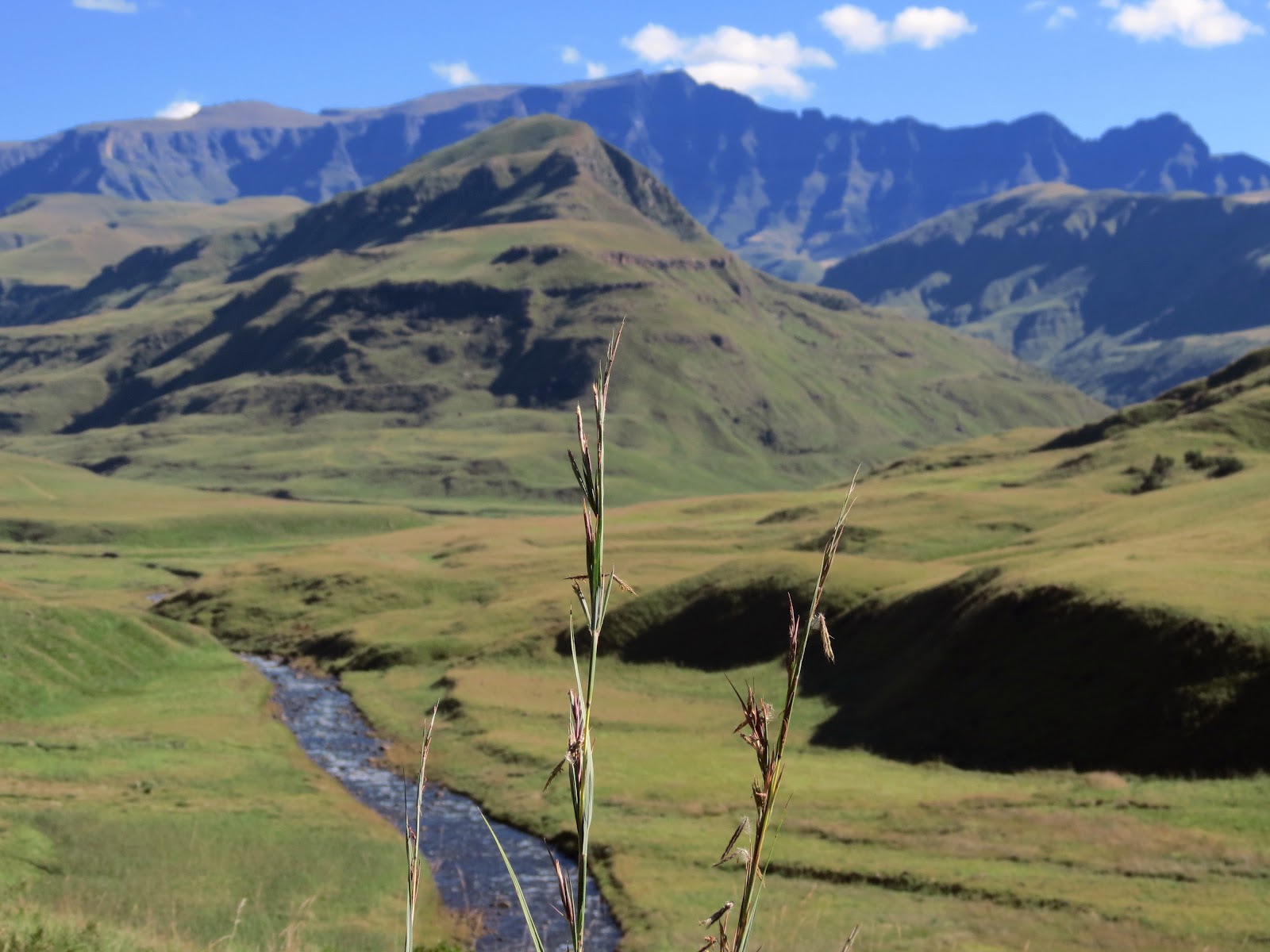
Loteni river with the Drakensberg escarpment in the distance, towering 3,000 metres above sea level.
In a previous post I wrote about the Mountain Rescue Register. Every entry point into the Drakensberg Wilderness Reserve has a Register. This register has to be filled in if you wish to hike or camp in the Berg. All relevant details, such as number of persons in the party, contact numbers, address, etc., - when hiking in the High Berg a minimum number of three persons is advised -, route to be hiked, (as exactly as possible) how far, how many days and when you will return. There are detailed hiking maps available at the Mountain Rescue Register. When you exit you have to sign out. If you don't return when you said you would a rescue party is sent out to look for you. Woe betide you if you returned and left without signing out, you will have made a lot of people very, very angry.
Part of the entrance fee to the reserve goes into a special rescue fund to cover rescue expenses. South Africa has highly skilled and experienced mountain rescue teams throughout the country. They consist experienced members of the South African Mountain Club, who are called in to help rescue people in trouble or lost on any mountain in South Africa. (These are all volunteers who drop whatever they are doing to rescue people, sometimes at extreme risk to their own lives). Police and Air Force helicopters are also available for rescue operations.
http://www.mcsa.org.za/cent/e_search_rescue/search_rescue.php
The Drakensberg can be extremely dangerous, like any other mountainous region in the world. In a matter of minutes the weather can change from sunny and warm to freezing cold, snow storms can occur in any month of the year even mid summer. During the summer months violent thunder storms occurring almost every day in the High Berg.
Next post, fly fishing and wild brown trout.
Land of mountains, rocks, antelope and more water.
A little way further down the road we came upon a road repair crew grading the gravel road. They were doing more than just grading away the corrugations on the road surface, but were busy with a major rebuilding of the road top. With the Caterpillar grader there was a Huge Bell tractor towing an even bigger road roller compactor.
Freshly graded road. On our return late that afternoon the crew were still at work. Further on we saw how well they had rebuilt the surface, it was almost like travelling on a tarred road.
Another farm sign. The name "Snow Top", shows how high the road is here. From here you can see a huge piece of southern KwaZuluNatal,(I'd hate to guess the size one can see, but it was several hundred square kilometres), with the Drakensberg stretching way to the south along the western edge.
The crest of the pass, from here it was down hill and hairpin bends into the Loteni valley. We had breakfast here, fresh buttered bread, boiled eggs, and hot strong coffee.
The first hairpin bend. Note the right hand top point of the mountain in the background, a close up of this point in the second photo after this.
This photo shows the steepness and winding nature of the road. This stretch of road has already been repaired and if you enlarge the photo you will see the surface is quite good.
Close up of the point referred to before, I call this the Loteni Sphinx, weather it actually has a name I don't know. You can see how huge pieces have broken away from the sandstone cliffs and fallen down the mountain.
Some of the huge blocks of rock that have broken off and rolled down the mountain. These boulders are very big.
This boulder was right next to the road, about three stories high. It looks a bit like the stern of a sinking ship, even has a rudder sticking out the back.
While I was photographing these boulders, the Italian leprechaun started shouting excitedly that I must look,"there goes an antelope". Sure enough there a Mountain reedbuck was racing up the side of the mountain. Taking photos almost by reflex I manage to get the following two photos.
Mountain Reedbuck, (Redunca fulvorufula).
Second photo. To appreciate it properly it needs to be enlarged by clicking on it. In the top right hand corner you can see the neck and head of another reedbuck peering over a small ridge.
Our first glimpse of the Loteni river, we still had about 5km to go before we got to the Nature Reserve.
More in the next post.
Land of mountains, streams, and waterfalls.
On Tuesday the 3rd, the Italian leprechaun, (a.k.a Enrico Bucceri) and I took a ride to the Loteni Nature Reserve in the southern Drakensberg. We left Estcourt in the dark at 5am, we had a long way to go and part of the road was bad. The reason for the trip? To fish for wild brown trout in the Loteni river.
The Loteni river has it's sources high up on the Drakensberg at about 10,000 feet. Along the way down it is joined by numerous tributaries of similar size, by the time it gets to about 5,000 feet it is a sizeable stream and the gradient, while still steep, becomes habitable to fish.
Along the way we stopped dozens of times to admire the view and to take photos. This is a real country road, passing first through lush farm land and eventually some very real mountain wilderness. The people are friendly and farmers in their pick-up trucks all wave and give you a smile as they drive past.
Click on pictures to enlarge.
Sunrise over the Kamberg Valley, all the hollows were filled with early morning mist.
A farm pond with sunlit hills in the background.
A farm sign along the road, the name of the farm intrigued me, I half expected to see Heathcliff to come striding along the road. The picture on the sign is of a wattled crane one of the rare crane species that can be found in this area.
One of the many mountain streams we crossed, name unknown.
Close-up of the waterfall on the stream above. Seeing this pool I was very tempted to set up my 2 weight fly rod, climb through the fence and cast a small nymph. All in the name of science of course, although trespassing, not poaching, just to scientifically prove that there were or weren't trout in the river.
The chances are very good that this stream holds a good trout population and has never, or hardly ever been fished. Most farmers I know don't seem to be very interested in fishing, they are too busy with the practicalities and problems of farming.
Another stream a few kilometres further along, flowing out of the Inkomasi Wetlands Nature Reserve. Many species of water birds occur in this reserve, especially cranes. Other species of birds also occur especially grass-land birds and birds that prefer higher altitude ecosystems.
The same stream looking upstream, and a very trouty looking stream it is. This is public land so one could fish here after buying a permit, (R50 about $7 US) at the reserve office. I think I will go and explore the fishing possibilities here soon. It's way of the beaten track so I wonder if it ever gets fished.
Plunging over a waterfall into a gorge, the dew on the grass in the middle distance glistening like silver in the early morning light.
Blue gums framing blue gums. Blue gums were imported from Australia during the 19th century and have thrived here. Almost every farm in the country has a few blue gum trees, usually around the house and farm buildings for shade. They seem to be able to grow in almost any climatic conditions. The trees in the photo above will be subjected to extremes of temperatures from sub zero and snow to very hot.
Huge commercial plantations of blue gums supply South Africa's very big mining industry with pit-props. Blue gums grow very fast here and the wood is hard and resistant to rot, it takes many decades for a piece of blue gum to decompose. After having been treated with creosote, blue gum wood is also used as fence posts, telephone poles and power line pylons.
From here we still had about 30km's to go.
Next post will cover the last half of the journey and a photo of an antelope that has become quite rare.
.
On Tuesday the Italian leprechaun and I drove to Loteni Nature Reserve in the Southern Drakensberg. It's only 120km, (+- 70 miles) from home but it took us about 3 hours. One of the reasons for taking so long was because we stopped after every other bend or rise in the road to ooh & ah at the stunning scenery and to take photos. The main reason for going was to fish for wild brown trout in the truly magnificent Loteni river.
Click on photo to enlarge.
Photo by Enrico Bucceri, a.k.a the Italian leprechaun.
Note the concentration as I watch my dry fly floating down a riffle. I never realised I stuck my tongue out when I'm concentrating so intensely.
Will have more posts on this trip in the next few days. I hope to find a map online to show you the route to, and the location of the Loteni Nature Reserve.
When I open my front door in the morning the dogs dash out to answer the call of nature, and my feathered friends know it's close to feeding time. They come flying in from all directions and take up positions on the fence, shrubs and trees around the garden.
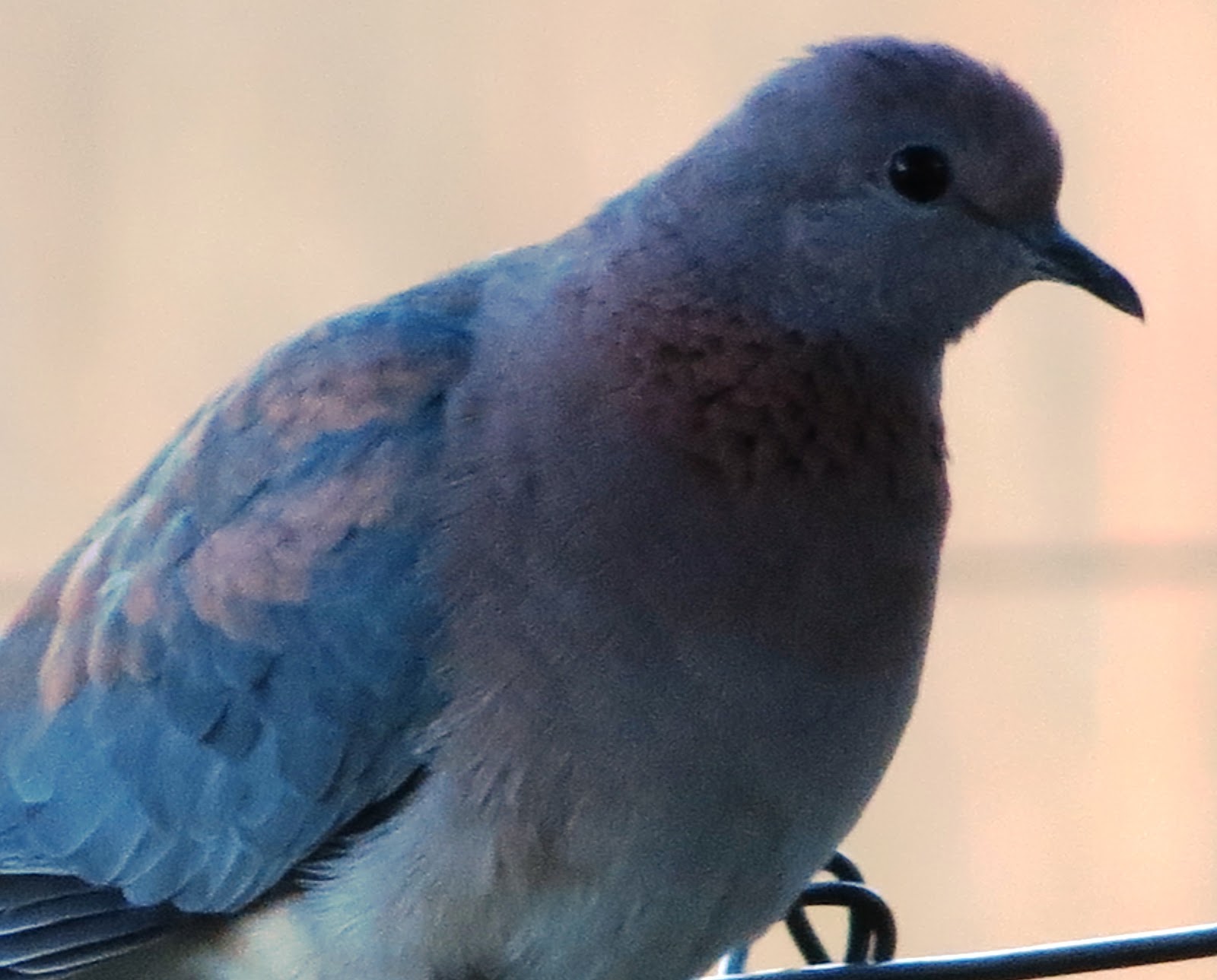
One of these feathered friends is this Laughing dove and it's mate.
Click on picture to enlarge.
Laughing dove. (Streptopelia senegalensi)
I have often photographed laughing doves as they are fairly common, but this morning the soft rosy light of the rising sun shining through a thin layer of cloud just did something to bring out the subtle colours of this bird, colours you just don't see in bright sunlight.
.