Friday, 10 June 2011

House keeper

Being a bachelor has some drawbacks, one being the inevitable slide into, well, one could almost say barbarism as far as the state of ones home goes. A women's main job in life is to civilize her man. Not having one to do this for me, I was well on the way to a very barbaric home life when Mrs Maria Zuma crossed my path.


Click on photo to enlarge.
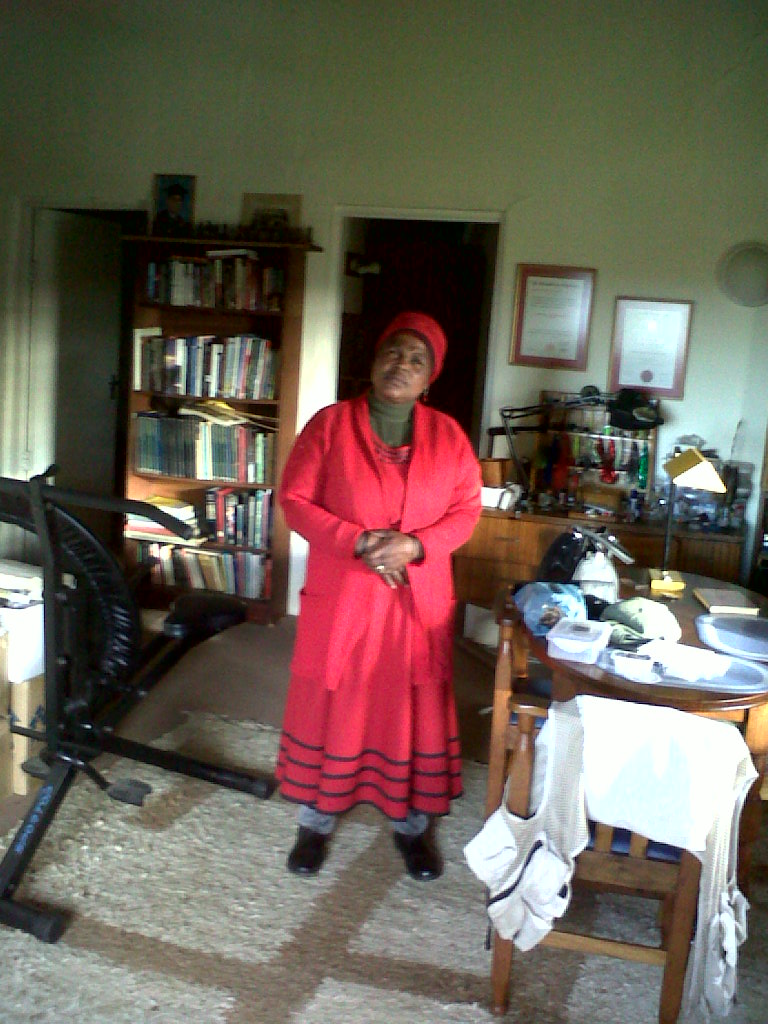

Took this picture of Maria this afternoon as she was preparing to leave, used my cell phone and she was unaware that I was photographing here, hence the puzzled look on her face when I called her. When she saw her photo she let out a indignant "HAUW" a word Zulus use when they are not happy with something. Told me in no uncertain terms that if she knew she was been photographed she would have smiled. Then she laughed at the fact that she was dressed totally in red. I told she looked very smart which pleased her no end. Women are all the same, just notice what they are wearing, compliment them, and they are happy.


As you can see by the fly fishing vest hanging over the chair, exercise machine, etc., Maria has not quite succeeded in her civilizing mission with this bachelor.


Maria started working for me 10 years ago while I was living on a farm 20km north of Estcourt near a small village called Frere. Her aunt asked me if I would not employ her as the family were having a hard time financially. At the time I was not in a much better position being self employed and living on a shoe string. We came to an agreement that she would work for me in the garden at R10 a day, little more than $1,(you can't buy much more than a couple of loaves's of bread with that). I would supply seed, fertilizer and gardening tools, she would do the work, we would split the income from the garden 50/50, and she could take vegetables home. Soon there was a flourishing garden and the locals were queuing up to buy the produce.


Before I knew it Maria was running my home too, cooking, washing, ironing and cleaning. 


Maria keeps complaining about fact that we don't have a vegetable garden here.


Maria is married with four children. Her husband Sipho is a very dignified looking man with a deep voice and a slow deliberate way of talking. He has decided that he is too old to work, (he is a long way from 60). Her oldest son Mondli is slightly retarded, due to a long and difficult birth. I helped her get a disability grant for him, which immediately put the family on a positive economic footing, (this is when Sipho decided he was too old to work). 


Sibonelo is the second eldest son, and his mother pride and joy. Sibonelo is a long distance truck driver. He also supports the family financially and buys such things as refrigerator's, TV's and other luxuries for the home. 


When things were financially difficult for the family, Sibonelo went to live with an uncle in Durban who, fed, clothed him, and paid his school fees. When he came home to Frere for the school holidays, he would come and visit me. He would greet me in Zulu "Sawubono Nkozana". Which means I see you sir. We would enquire about each others health, how his school work was going, etc. I would fetch him a cool drink and a snack, then he would sit on the floor floor at my knee for an hour or more not saying anything. Then as quietly as he came he would get up and greet me in Zulu, "Salle kahle Nkozana, which means stay well, and leave. This happened every holiday. Today he is a grown man and he at least agrees to sit on a chair, he is still as quiet as ever though.


Then there is a daughter, Gugu, who is studying catering and hospitality management, who wants to follow a career in tourism. Lastly is the youngest so S'Ne (short for S'Nenhlanhla) who is in grade 10. A quiet well behaved boy who's only concession to being a teenager is a small gold stud in his left ear. He is also a very snazzy dresser. S'Ne wants be a truck driver like his big brother.


Maria is a very intelligent woman, but she has had very little education and can speak no English. My Zulu has improved by leaps and bounds since she has worked for me. Maria works three days a week for me, while she is here she has her radio on Nkozi FM, the Zulu radio station. So the only news I hear is in Zulu, improving my Zulu still more.


As my financial position improved so has my ability to pay her, she now earns much more than R10 a day, I also pay her taxi fare to and from work. Maria has been such a blessing to me that whatever I pay her won't be enough. More like a sister to me than a servant, and although she is younger than me, sometimes a mother. She often reminds me not to worry too much about this life, because in our Fathers house there are many mansions waiting for us.


Wednesday, 8 June 2011

Winter rain

Woke up this morning to overcast skies, which is very unusual for this time of the year. This part of the country is summer rainfall area. Come winter, come the long dry months. This year is very different.

This is the scene that greeted us at school this morning, sodden playing fields.

By 11:30 the rain had turned into a deluge. I stood in the doorway of our computer centre to take this photo. It rained until about 1pm and then suddenly the clouds lifted. Looking out of our staff room window we could see that the whole Drakensberg was covered in a thick blanket of snow. Thought I would take some photos of the mountains on my way home but the clouds came down again. See if I can get some good ones tomorrow on my way to work.

In a dry country such as ours we don't complain too much if it rains. Un-seasonal rains bring their own set of problems though. At this time of the year farmers should be burning fire-breaks to prevent runaway veld-fires. But the grass is still too damp. End of July, through August into September is our fire season. From the end of July hot dry winds start blowing of the Berg turning the veld into tinder. Once a fire starts and fanned by the wind, nothing but good fire-breaks can stop it. Sometimes even fire-breaks don't help much.

With the good rains we've had this summer there is lots of combustible material out in the veld. What we need now is a couple of nights of heavy frost to help the drying process so farmers can burn fire-breaks.

Tuesday, 7 June 2011

Rhino poaching

South Africa has recently become the scene of serious Rhino poaching. Over the years South African conservationists and game reserves have developed a reputation for conserving threatened species. The white rhino was brought back from the brink of extinction (50 animals at the beginning of the 20th century) and is today flourishing.


Most of the worlds surviving rhinos are found in South Africa. Today these animals are being slaughtered at an alarming rate. In 2008, 89 rhino's were poached, in 2009, 109, in 2010, 333, and so far this year, 173. 


Poachers are willing to risk life and limb, and freedom, in their efforts to get rhino horn. Last year 122 poachers were arrested in South Africa, 60 of them in the Kruger National park. So far this year 20 poachers have been killed and 10 injured in clashes with law enforcement agencies, which include the South African National Defence force, which has been called in to patrol the borders of parks such as KNP, South African Police Service, and SANParks, (South African National Parks) rangers.  


The Kruger National Park can be seen in the North East corner of this map.


One of the problems conservationists face is the huge size of some of South Africa's game parks. Kruger National Park is larger than some European countries at 7,332 sq miles. Kruger Park also has 220 miles of international border to patrol. One game park in KwaZuluNatal has 96,000 hectares of wilderness area, which means no roads and 14 rangers to patrol it.   


At a price of $60,000 dollars a kilogram, more expensive than heroin, poachers are very prepared to take risks. In the past poaching was mainly done by subsistence poachers trying to survive. Today poaching is carried out by well financed and equipped criminal syndicates. Helicopters, night vision equipment and high powered silenced rifles, rhinos are even darted with tranquilizer dart guns and their horns hacked off. 


The demand for rhino horn is driven by the believe that it can cure many diseases, from cancer to AIDS, not to mention the old favourite impotence. None of these beliefs has any foundation in scientific fact but that does not curb the demand.


In the 1960's Africa had 100,000 rhino's, today there are very few left 90%, 21,000, of the rhinos  are found in SA. As countries such as China and Vietnam become richer so the demand for rhino horn increases.


White rhino. The name white comes from the corruption of the Dutch word weit, meaning wide, referring to it's wide top lip. The white rhino is a grass grazer.


Black rhino and calf. The black rhino has a prehensile top lip and it's a browser, living of leaves.


This is what a white rhino looks like when the poachers are finished with it, one of two poached during the last two weeks in KZN reserves. 


The cause of all this wanton slaughter? Money.

Sunday, 5 June 2011

Winter sunrise

Sunrise this morning 6:10am. Winter arrived with a bang June the first. Woke up to find my car covered with a thin layer of ice. This morning was chilly but not so cold. Temperatures this last week have averaged between minus 3 and 0 degrees Celsius. Strangely though not much frost here on the farm yet.


Quote: Love begins when the needs of someone else become more important than our own. Lao Wei.

Saturday, 4 June 2011

Black mamba

The black mamba is Africa's most venomous snake and one of the 10 most venomous snakes in the world. Without treatment bites from this snake are 100% fatal. These snakes average between 1.4 to 2.5 meters in length, but snakes of 4 meters plus have been recorded. Black mambas are the worlds fastest land snake averaging between 11 and 19km an hour over long distances and have been known to reach speeds of 23km an hour. The snake is not actually black, ranging in colour from dark grey to gun metal blue, it gets it's name from the colour of it's mouth inside.

When threatened the snake will raise up to one third of it's body off the ground, stretch the flaps on it's neck wide,much like a cobra, and make a loud hissing sound. If this does not frighten it's perceived foe away it will strike several times very swiftly, often landing it's bites on the body or head of the victim. One bite is said to contain enough venom to kill up to 20 grown men.

 Experts say this is the worlds most dangerous snake. But like most snakes it tries to avoid confrontation, it's only when it's cornered and can't escape that it resorts to attack.

Black mambas play an important role in combating pests such as rats and mice. The black mamba's deadliest enemy is the yellow mongoose, which is immune to it's venom.


What got me thinking of these snakes was reading a short story by Herman Charles Bosman. In the *Withaak's Shade.


I told my story over several times before the lorry came with our letters, and although the dozen odd men present didn't say much while I was talking, I could see they listened to me in the same way that the listened when Krisjan Lemmer talked. And everyone knew Krisjan Lemmer was the biggest liar in the Bushveld.


To make matters worse, Krisjan Lemmer was there too, and when I got to the part where the leopard lay down beside me, Krisjan Lemmer winked at me. You know that kind of wink. It was to let me understand that there was now a new understanding between us, and we could speak in future as one Marico liar to another.


I didn't like that.


"*Kerrels," I said in the end, "I know just what you are thinking. You don't believe me, and you don't want to say so."
"But we do believe you," Krisjan Lemmer interrupted me, "very interesting things happen in the Bushveld. I once had a twenty-foot mamba that I named Hans. This snake was so attached to me that I couldn't go anywhere without him. He would even follow me to church on Sunday, and because he didn't care much for some of the sermons, he would wait for me under a tree. Not that Hans was irreligious. But he had a sensitive nature, and the strong line that the *predikant took against the serpent in the Garden of Eden always made Hans feel awkward. Yet he didn't go and look for a withaak to lie under, like your leopard. He wasn't stand-offish in that way. An ordinary thorn-tree's shade was good enough for Hans. He knew he was only a mamba, and he didn't try to give himself airs."


*Withaak, a species of thorn-tree with hook like thorns.
*Kerrels, men, or guys.
*Predikant, preacher. 

Western hairline crescent moon.

Quote: True faith produces a life full of actions, not a head full of facts. Author unknown.

Last night the Italian leprechaun and I had our monthly get together and braai, (BBQ). As the sun was setting he pointed out the western hairline crescent moon. Just a sliver of moon that got brighter and brighter as the sun set. On Tuesday, four days before, there was an eastern hairline crescent moon as the son rose. The universe works with clock work precision so once you see the eastern hairline crescent moon, you can be sure that four days later you will see it in the west. This is the second time he has pointed this phenomenon out to me.

According to the materialists this precision all happened by chance. Well all I can say is, fat chance!

Click on photos to enlarge.

The hairline crescent moon can just be seen between the trees. Later you could see the outline of the whole moon due to light reflecting of Earth.

The Italian leprechaun is very knowledgeable about things astronomical, and he carries this knowledge  and enthusiasm over to his students. On Tuesday he showed the learners who stay in the school hostel the eastern hairline crescent moon and last night they were on the lookout for the one in the west.

Here the moon is a bit brighter as it got darker.

I'm off to the bigger of the two dams on the farm to try my hand at winter bass fishing. Who knows maybe my luck will change today.

Thursday, 2 June 2011

Sangoma.

In my post about rape and the possible influence a Sangoma might have had on the rapist and his decision to rape a young girl, believing that sex with a virgin will cure him of AIDS. Sangomas used to have huge influence on the tribal life of Zulus in the past. There are some who claim that the Sangoma's influence was mainly beneficial and that they were a force of good in society. 


Here is an excerpt from Donald R Morris's book, The Washing of the spears.


Witchcraft was universal. All illness, and indeed all evil, was caused by abaThakathi - wizards who made use of primal forces. An umThakathi was disembodied, and might inhabit an animal or plant or even a rock while blighting the neighborhood. It frequently inhabited a human being-anyone but a witch doctor or a chieftain, who was actually an umThakathi (but a benign one) himself. The unfortunate host would be quite unaware of the parasite until a witch doctor pointed it out; witch doctors could smell abaThakathi.


An accusation of witchcraft was fatal; one a wizard had been smelled, no defence was possible, and because the host was quite unwitting, no plea of ignorance, purity of action, or innocence of intention could stand. Whenever the presence of an umThakathi was suspected, the chieftain would summon the entire male membership of the clan, which assembled in a large circle with the witch doctors in the centre. These worthies, bedaubed with clay and bedecked with outlandish ornaments had long since worked themselves into a frothing frenzy of concentration. They slowly strutted around the circle, chanting a single word to a low counterpoint from the clan. They paused in front of each man, sniffing and howling, passing on and suddenly darting back to terrorize anew someone just starting to breath again, and as a really likely prospect was approached, the chant would rise in volume. The clan might think the rising volume was the witch doctors making, but they in turn were merely sounding out public opinion, cleverly reinforcing nuances of sound until they were certain their choice met with popular approval - a rich but miserly kraal head, or the transgressor of some social taboo. The witch doctors would pass him and return, until finally they were leaping and screaming before some poor wretch on his knees. Bounding clean over him, the flicked him with a gnu's tail, whereupon he was at once dragged off to have sharpened stakes pounded up his rectum, while an impi was dispatched to exterminate his family root and branch, destroy his crops, and burn his kraal. His cattle were simply added to the royal herd with, of course, a cut to the witch doctors.  .....


....Witch doctors also waxed fat on private practise. They were called in as consultants for every form of minor crises, and rarely failed to secure the payment of at least a goat. The vicious grip in which they held the people was made possible by an implicit and universal belief in magic; not even the victim of a smelling out was indignant. He might register horror or fear or remorse, but not even in his final painful moments did he doubt the existence of the wizard that had possessed him.


Sangomas are actually Shamans, and in the follower of the New Age movement, Shamans are seen as something positive and good. Sangomas might not have the power they used to have but they still have a great influence in many parts of Africa. Every year you hear of muthi murders. These are murders committed to obtain certain human body parts for the purposes of making powerful medicine. Children are often the victims of these murders. Every year people are killed because they are suspected of being wizards.


Sangomas, Shamans, call them what you will all have their roots in the same darkness.


In the Western World today there is a growing interest in magic, the occult and the practise thereof. Will we in the future see a return to those old practices of the Druids which were similar to those of the Sangomas? 


In South Africa today there is a growing number of initiated white Sangomas, and they have a loyal white following. Some practise overseas, giving lectures on drumming and chanting to call up the ancestral spirits.