"Dorp" is the Afrikaans word for small town, and Estcourt is a small town. Had to go into town very early this morning to draw money at my banks ATM, get there too late and you have queues half way round the block, especially here at the beginning of the month.
Took my camera with to get some sunrise shots over our "dorp".
Click to enlarge.
Sunrise over our "dorp". Just behind where I was standing is the towns water works, the water in Estcourt is very, very good. The tree covered area centre right of the photo is known in Afrikaans as "Skuld bult," translation "Debt Hill", a k a "Snob Hill". The road on the left is the one I use coming in to work every day.
Top end of Wagen (Wagon) Road, on "Skuld Bult", the school I'm librarian at is about 100 meters behind me at this point.
Heading down "Wagen road", the poor oxen must have sweated pulling loaded wagons up this hill.
Not many towns can claim to have their biggest factory right in the CBD! Directly ahead is the Nestle coffee factory, said to be the biggest coffee producer in the Southern hemisphere, and as you can see they are busy enlarging the plant so as to double it's capacity. Do South Africans like their coffee or what? Here you don't have to stop and smell the coffee, all day long you have the smell of roasting coffee beans permeating the air.
Harding street, the "Dorp's" main thoroughfare, the Nestle coffee factory is just to the left of me at this point. Just across the street on the right are the old Civic buildings, now a National monument. Where the three palm trees are with the two flag staff you can just see part of the Town Hall peeping out.
Albert street, named after Queen Victoria's husband, there is also a Victoria road. The ATM's I made use of are just to my left. On the right you will see a café advertising Halal Food. Most of the businesses in this street are Muslim owned.
Estcourt has a large Muslim community with several mosques. I have made very good friends with several Muslims especially during the time I though I might make my fortune as a businessman, The only people who ever helped me with credit, cash loans, (no security, no interest) were Muslims. There is one to whom I still owe thousands, when I told that the business was going down the tubes and there was no way I could repay him, he shrugged his shoulders and said "ins Allah" (God wills), patted me on the shoulder and told me to forget about it, and that I must never ever think about it again. To this day we are still good friends and I always get a great big bear hug as greeting when we meet.
Estcourt has several other large factories apart from the coffee factory. South Africa's iconic "Eskort bacon" is produced here. When the founders of this business round about the late 1920's approached the town fathers to be allowed to use the town's name as their product name, the horrified answer was a flat "NO!" use the town's name how very low class, thus the spelling "Eskort". There is a huge factory that makes "Masonite" (a tough, hard pressboard) out of low grade timber, a very big milk powder factory, that produces tens of thousands of tons of milk powder for export. There are also a wide range of smaller manufacturers, producing a wide range of goods.
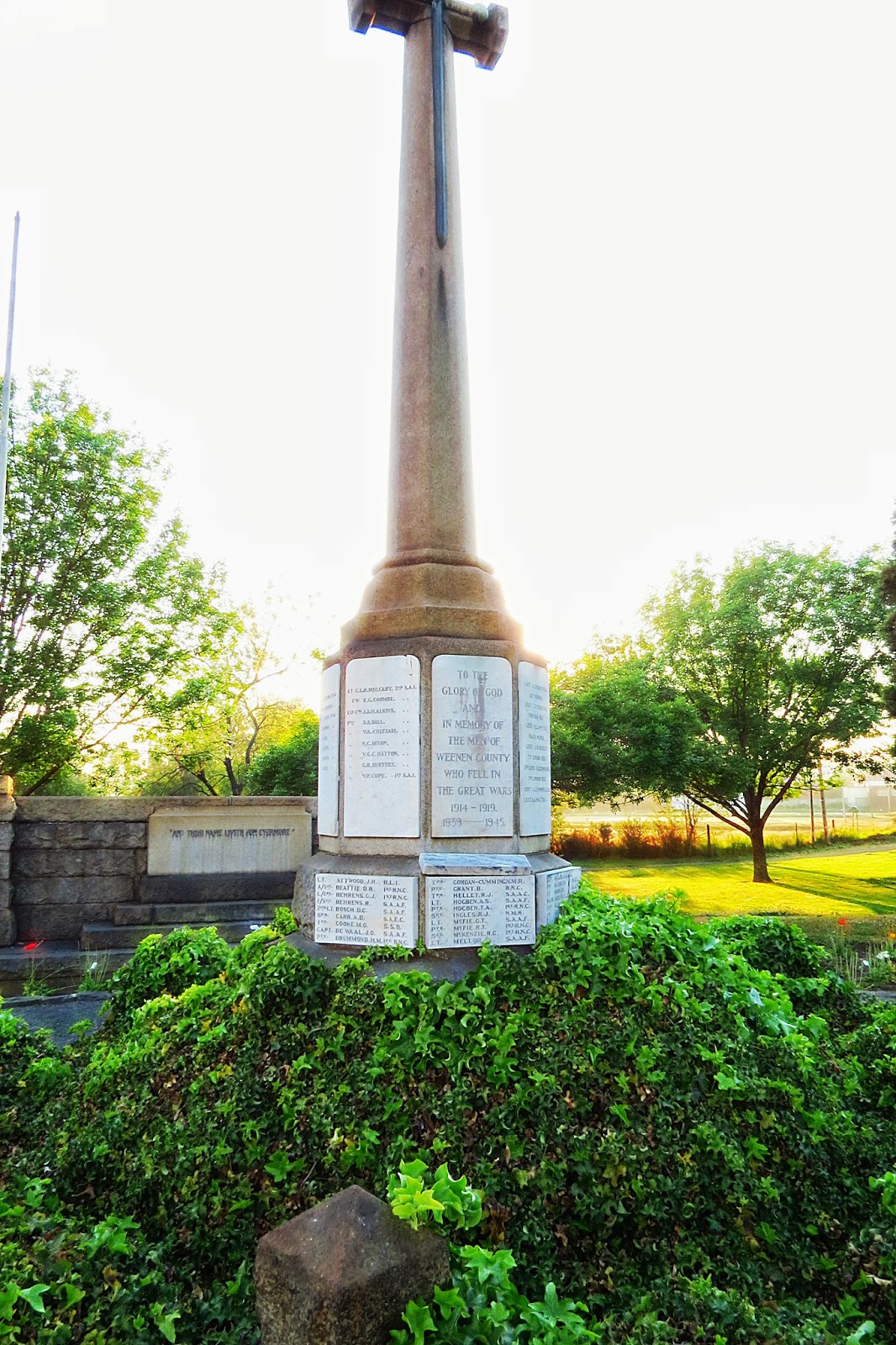
Of course every "dorp" has a garden of remembrance, does not matter how small the "dorp" is there is always one commemorating it's sons who fell during the two World War's and other conflicts. More about this in the next post.
Showing posts with label sunrise. Show all posts
Thursday, 3 October 2013
Saturday, 8 June 2013
African sunrise.
Looking out of my front door at about 6 am yesterday I saw the beginning of a beautiful sunrise. The sun would only show above the horizon at +/- 6:52 am, but the sky was already starting to glow.
Click to enlarge.
Stopped at the spot where the farm road enters the main road to town. Took this photo looking south east at about 6:35 am.
Pulled off the road about 1 km from town and saw this cloud formation in the west turning a rosy pink as the sun rays lit it up from the east.
Looking south east.
And another day about to be born.
Click to enlarge.
Stopped at the spot where the farm road enters the main road to town. Took this photo looking south east at about 6:35 am.
Pulled off the road about 1 km from town and saw this cloud formation in the west turning a rosy pink as the sun rays lit it up from the east.
Looking south east.
And another day about to be born.
Thursday, 30 May 2013
Sunrise.
Stopped on the way to work this morning to photograph the sunrise.
Click to enlarge.
Stood for several minutes in the cold wind waiting for the sun to appear.
Click to enlarge.
Stood for several minutes in the cold wind waiting for the sun to appear.
Tuesday, 14 August 2012
Sunrise panoramas.
On my way to work this morning I took a little detour to see if I could get an early morning photo of the sun shining on the Drakensberg. I took several photos then "stitched" them together to form panoramas. I didn't get the "stitching" absolutely right, but with practise I might just. After stitching them I manipulated them further.
Click to enlarge.
Looking westward, with the sun rising behind me.The two halves don't have exactly the same exposure, the photo on the left is lighter and one can see where they join in the middle.
The same photo , now a water colour painting.
In this panorama I zoomed in to show more of the Drakensberg, about 35km from where I was standing. The N3 highway can be see running north/south in the middle.
Here the photo has become an oil painting.
Click to enlarge.
Looking westward, with the sun rising behind me.The two halves don't have exactly the same exposure, the photo on the left is lighter and one can see where they join in the middle.
The same photo , now a water colour painting.
In this panorama I zoomed in to show more of the Drakensberg, about 35km from where I was standing. The N3 highway can be see running north/south in the middle.
Here the photo has become an oil painting.
Monday, 18 June 2012
Venus rising.
At my normal post this morning just making sure the sun rises on time, when I saw Venus high and bright in the sky. This morning at sunrise there was an eastern hairline moon rising, with Venus and Saturn. Due to the trees being in the way I could not see the moon. On Thursday evening just after sunset there will be a western hairline moon with Venus, on the western horizon, and I should be able to photograph them both.
Click to enlarge.
`Looking for the eastern hairline moon.
Venus peeping shyly through the leaves.
Venus magnified through the camera lens.
For those interested in the technical details of the above shot;
Camera; Canon PowerShot SX40
Mode: Manual mode
Shutter: 1/10 second
App: f5.8
ISO: 3200
Lens: 150.5mm focal length.
Sunrise this morning wasn't too shabby either.
Click to enlarge.
`Looking for the eastern hairline moon.
Venus peeping shyly through the leaves.
Venus magnified through the camera lens.
For those interested in the technical details of the above shot;
Camera; Canon PowerShot SX40
Mode: Manual mode
Shutter: 1/10 second
App: f5.8
ISO: 3200
Lens: 150.5mm focal length.
Sunrise this morning wasn't too shabby either.
Sunday, 17 June 2012
Early morning splendour.
Every week I tell myself the same thing, "come Sunday and I'm going to lie in a bit." Come Sunday, what happens? I'm up at my usual time, drinking my first cup of coffee. This morning was no different, I sat in my chair watching the sun come up. Being mid winter the sun only comes up at 06:50, and I had been up since 5:30. (This is about 40 minutes later than my usual time, so I suppose I did lie in a bit).
Then, as if on cue, the show began.
Five minutes later the sun is visible through the branches.
And suddenly the whole glowing ball is visible, almost seems to be shaking itself free of the clutching branches.
Even though I watch the sunrise most mornings, and have a fair understanding of the physical laws behind the spectacular light, I'm still enthralled by it just as Adam must have been when he saw his first sunrise.
Thursday the 21st is our winter solstice, and from Friday the sun starts rising a fraction earlier every morning so that by mid December it's up almost two and a half hours earlier than now. By November the sun and I will be in sync again, both up at the same time.
Then, as if on cue, the show began.
Five minutes later the sun is visible through the branches.
And suddenly the whole glowing ball is visible, almost seems to be shaking itself free of the clutching branches.
Even though I watch the sunrise most mornings, and have a fair understanding of the physical laws behind the spectacular light, I'm still enthralled by it just as Adam must have been when he saw his first sunrise.
Thursday the 21st is our winter solstice, and from Friday the sun starts rising a fraction earlier every morning so that by mid December it's up almost two and a half hours earlier than now. By November the sun and I will be in sync again, both up at the same time.
Saturday, 16 June 2012
Sunrise from my front door.
The cold, dry weather that we are having at moment, creates perfect atmospheric conditions for dramatic sunrises and sunsets. This morning while I was having my coffee I watched the sun rising like a big red ball.
Click to enlarge.
The dust haze reduces the amount of 'flare', that would normally occur when shooting directly into the sun, without some sort of filter.
Click to enlarge.
The dust haze reduces the amount of 'flare', that would normally occur when shooting directly into the sun, without some sort of filter.
Saturday, 26 May 2012
Sunrise from my front door.
Sitting in my favourite chair, drinking coffee, watching the birds feeding, I saw the sun peeping through the branches at me. Grabbed my camera to get the evidence before he could deny it.
Caught in the act, 6.50am
Getting bolder, 6.53am. Evidence that would satisfy any court.
.
Caught in the act, 6.50am
Getting bolder, 6.53am. Evidence that would satisfy any court.
.
Wednesday, 16 May 2012
Shades of orange and red.
Some yellow to.
Click to enlarge.
Sunrise this morning on my way to work. In the sunrise photos I took last week the sun was coming up behind the flat topped acacia in the middle of the photo, as the winter progresses the sun will move further and further to the left of the photo, which is north.
These large poinsettia flowers grow just outside the school libraries door. The flower petals and the leaves are almost the same size. Two years ago (2010) we had a very harsh winter with black frost, I thought this plant would never recover, but it did.
This tree flowers virtually right through the year, but at the moment it is particularly lush and beautiful.
.
.
Click to enlarge.
Sunrise this morning on my way to work. In the sunrise photos I took last week the sun was coming up behind the flat topped acacia in the middle of the photo, as the winter progresses the sun will move further and further to the left of the photo, which is north.
These large poinsettia flowers grow just outside the school libraries door. The flower petals and the leaves are almost the same size. Two years ago (2010) we had a very harsh winter with black frost, I thought this plant would never recover, but it did.
This tree flowers virtually right through the year, but at the moment it is particularly lush and beautiful.
.
.
Friday, 27 April 2012
Sunrise, weaver birds, sparrows, Cape robin chat & Fork-tailed drongo.
All that in the title and I didn't even have to leave the house.
Started using the new Blogger and getting used to it.
Click on photos to enlarge.
While standing at my front door drinking my early morning coffee I noticed the light from the rising sun, shining through the autumn leaves of this tree about a hundred metres from the cottage.
After scattering bird seed as I usually do I photographed these weaver birds and sparrows having breakfast.
A group of sparrows enjoying their share.
While sitting at the window in my lounge reading I spotted this Cape Robin Chat, sitting on the edge of my braai (BBQ) stand, an old plough shear on three re-bar legs. The plough shear was filled with water and the chat felt like a bath.
Close up of the chat. The bird never had it's bath as it did not like the big, black Cyclops eye staring at it through the window.
Fork-tailed drongo, also taken while sitting in my chair at the lounge window.
Started using the new Blogger and getting used to it.
Click on photos to enlarge.
While standing at my front door drinking my early morning coffee I noticed the light from the rising sun, shining through the autumn leaves of this tree about a hundred metres from the cottage.
After scattering bird seed as I usually do I photographed these weaver birds and sparrows having breakfast.
A group of sparrows enjoying their share.
While sitting at the window in my lounge reading I spotted this Cape Robin Chat, sitting on the edge of my braai (BBQ) stand, an old plough shear on three re-bar legs. The plough shear was filled with water and the chat felt like a bath.
Close up of the chat. The bird never had it's bath as it did not like the big, black Cyclops eye staring at it through the window.
Fork-tailed drongo, also taken while sitting in my chair at the lounge window.
Wednesday, 25 April 2012
Sunrise.
No, I haven't stopped blogging just been busy with all sorts of other things. Among others tying some flies to use on the last few days of river and stream trout fishing in our part of the world. Trout streams close on the 1st of May and stay close until the 1st of September to allow trout to spawn undisturbed. Fortunately this coming weekend is a long weekend so there is enough time to get some stream fishing done. For the next four months it will be still water fishing and I'm looking forward to bobbing around on a large still water in my float tube.
In the meantime I thought I would post these photos of sunrise I took on my last trip to Lotheni.
Click on photos to enlarge.
Sunrise across the Kamberg valley.
Drakensberg foothills touched by the first rays of the sun.
Shadows and light.
Rock overhang gets a soft, warm glow from the early morning light.
Stern of the "Titanic" lit by the first rays.
Early morning light through an avenue of trees.
.
In the meantime I thought I would post these photos of sunrise I took on my last trip to Lotheni.
Click on photos to enlarge.
Sunrise across the Kamberg valley.
Drakensberg foothills touched by the first rays of the sun.
Shadows and light.
Rock overhang gets a soft, warm glow from the early morning light.
Stern of the "Titanic" lit by the first rays.
Early morning light through an avenue of trees.
.
Thursday, 5 April 2012
Road to Loteni (1)
Land of mountains, streams, and waterfalls.
On Tuesday the 3rd, the Italian leprechaun, (a.k.a Enrico Bucceri) and I took a ride to the Loteni Nature Reserve in the southern Drakensberg. We left Estcourt in the dark at 5am, we had a long way to go and part of the road was bad. The reason for the trip? To fish for wild brown trout in the Loteni river.
The Loteni river has it's sources high up on the Drakensberg at about 10,000 feet. Along the way down it is joined by numerous tributaries of similar size, by the time it gets to about 5,000 feet it is a sizeable stream and the gradient, while still steep, becomes habitable to fish.
Along the way we stopped dozens of times to admire the view and to take photos. This is a real country road, passing first through lush farm land and eventually some very real mountain wilderness. The people are friendly and farmers in their pick-up trucks all wave and give you a smile as they drive past.
Click on pictures to enlarge.
Sunrise over the Kamberg Valley, all the hollows were filled with early morning mist.
A farm pond with sunlit hills in the background.
A farm sign along the road, the name of the farm intrigued me, I half expected to see Heathcliff to come striding along the road. The picture on the sign is of a wattled crane one of the rare crane species that can be found in this area.
One of the many mountain streams we crossed, name unknown.
Close-up of the waterfall on the stream above. Seeing this pool I was very tempted to set up my 2 weight fly rod, climb through the fence and cast a small nymph. All in the name of science of course, although trespassing, not poaching, just to scientifically prove that there were or weren't trout in the river.
The chances are very good that this stream holds a good trout population and has never, or hardly ever been fished. Most farmers I know don't seem to be very interested in fishing, they are too busy with the practicalities and problems of farming.
Another stream a few kilometres further along, flowing out of the Inkomasi Wetlands Nature Reserve. Many species of water birds occur in this reserve, especially cranes. Other species of birds also occur especially grass-land birds and birds that prefer higher altitude ecosystems.
The same stream looking upstream, and a very trouty looking stream it is. This is public land so one could fish here after buying a permit, (R50 about $7 US) at the reserve office. I think I will go and explore the fishing possibilities here soon. It's way of the beaten track so I wonder if it ever gets fished.
Plunging over a waterfall into a gorge, the dew on the grass in the middle distance glistening like silver in the early morning light.
Blue gums framing blue gums. Blue gums were imported from Australia during the 19th century and have thrived here. Almost every farm in the country has a few blue gum trees, usually around the house and farm buildings for shade. They seem to be able to grow in almost any climatic conditions. The trees in the photo above will be subjected to extremes of temperatures from sub zero and snow to very hot.
Huge commercial plantations of blue gums supply South Africa's very big mining industry with pit-props. Blue gums grow very fast here and the wood is hard and resistant to rot, it takes many decades for a piece of blue gum to decompose. After having been treated with creosote, blue gum wood is also used as fence posts, telephone poles and power line pylons.
From here we still had about 30km's to go.
Next post will cover the last half of the journey and a photo of an antelope that has become quite rare.
.
On Tuesday the 3rd, the Italian leprechaun, (a.k.a Enrico Bucceri) and I took a ride to the Loteni Nature Reserve in the southern Drakensberg. We left Estcourt in the dark at 5am, we had a long way to go and part of the road was bad. The reason for the trip? To fish for wild brown trout in the Loteni river.
The Loteni river has it's sources high up on the Drakensberg at about 10,000 feet. Along the way down it is joined by numerous tributaries of similar size, by the time it gets to about 5,000 feet it is a sizeable stream and the gradient, while still steep, becomes habitable to fish.
Along the way we stopped dozens of times to admire the view and to take photos. This is a real country road, passing first through lush farm land and eventually some very real mountain wilderness. The people are friendly and farmers in their pick-up trucks all wave and give you a smile as they drive past.
Click on pictures to enlarge.
Sunrise over the Kamberg Valley, all the hollows were filled with early morning mist.
A farm pond with sunlit hills in the background.
A farm sign along the road, the name of the farm intrigued me, I half expected to see Heathcliff to come striding along the road. The picture on the sign is of a wattled crane one of the rare crane species that can be found in this area.
One of the many mountain streams we crossed, name unknown.
Close-up of the waterfall on the stream above. Seeing this pool I was very tempted to set up my 2 weight fly rod, climb through the fence and cast a small nymph. All in the name of science of course, although trespassing, not poaching, just to scientifically prove that there were or weren't trout in the river.
The chances are very good that this stream holds a good trout population and has never, or hardly ever been fished. Most farmers I know don't seem to be very interested in fishing, they are too busy with the practicalities and problems of farming.
Another stream a few kilometres further along, flowing out of the Inkomasi Wetlands Nature Reserve. Many species of water birds occur in this reserve, especially cranes. Other species of birds also occur especially grass-land birds and birds that prefer higher altitude ecosystems.
The same stream looking upstream, and a very trouty looking stream it is. This is public land so one could fish here after buying a permit, (R50 about $7 US) at the reserve office. I think I will go and explore the fishing possibilities here soon. It's way of the beaten track so I wonder if it ever gets fished.
Plunging over a waterfall into a gorge, the dew on the grass in the middle distance glistening like silver in the early morning light.
Blue gums framing blue gums. Blue gums were imported from Australia during the 19th century and have thrived here. Almost every farm in the country has a few blue gum trees, usually around the house and farm buildings for shade. They seem to be able to grow in almost any climatic conditions. The trees in the photo above will be subjected to extremes of temperatures from sub zero and snow to very hot.
Huge commercial plantations of blue gums supply South Africa's very big mining industry with pit-props. Blue gums grow very fast here and the wood is hard and resistant to rot, it takes many decades for a piece of blue gum to decompose. After having been treated with creosote, blue gum wood is also used as fence posts, telephone poles and power line pylons.
From here we still had about 30km's to go.
Next post will cover the last half of the journey and a photo of an antelope that has become quite rare.
.
Subscribe to:
Posts (Atom)


