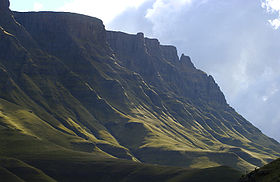
Your intrepid African fly fisherman braved the dangers and hardships of Africa to bring you one photo of one 6 inch rainbow trout. Even if though I say so myself, a very beautiful little fish and worth all the effort to catch it.
Click to enlarge.
Wild rainbow, this stream was stocked once more than a hundred years ago and never again. Since then these fish have thrived and flourished here in the cool, pure, crystal clear waters.
The best part though is I caught it on a fly I tied myself, a Zack nymph, (a South African fly) and with a 2 weight fly rod I built. This little fish gave a very good account of itself in the fast water, putting a serious bend in the 2 weight.
The setting, Injasuthi Nature Reserve.
The flat rock and it's pool. (See dialog below).
While I was assembling my fly rod next to the road bridge crossing the stream, a car (huge 4 x 4 actually) stopped next to me and a young man stuck his head out, and said, "Walk down stream about 200 meters to a big flat rock and you'll find great fishing in the pool below it. Fish on the bottom with a weighted nymph and add some split shot to keep the fly down, the water is deep, and the fish are holding right on the bottom". Then he drove off with a wave and, "Good fishing".
I first tried my luck about 50 meters upstream, where I have often fished, missed several strikes, then decided to follow the young mans advice and head downstream. Just below the bridge was a nice looking bit of water so I decided to try there first. But I eventually gave up, not because I thought I would not catch anything but because I got tired of waving back and greeting everyone as they drove or walked over the bridge. South Africans are a friendly lot and will greet, and talk to, anyone and everyone. So I headed downstream to the fabled flat rock and it's pool full of fish.
Easier said than done, usually one could walk right next to the stream, but the water was up, bank to bank, so it meant walking through the bush and grass above the stream bank. Now in theory that doesn't sound too bad but the grass is a meter to a meter and a half tall, it's hard and tough, to add to the fun, there are hard tough shrubs, just as tall, (or taller) and thorn bushes. Furthermore you are walking on boulders from the size of your fist to the size of your head. The grass is so thick you can't see the ground so you put your feet down hoping to luck, and this is great snake country. As I pushed and struggled my way through this "jungle" I kept thumping my wading staff on the ground to scare of any snakes.
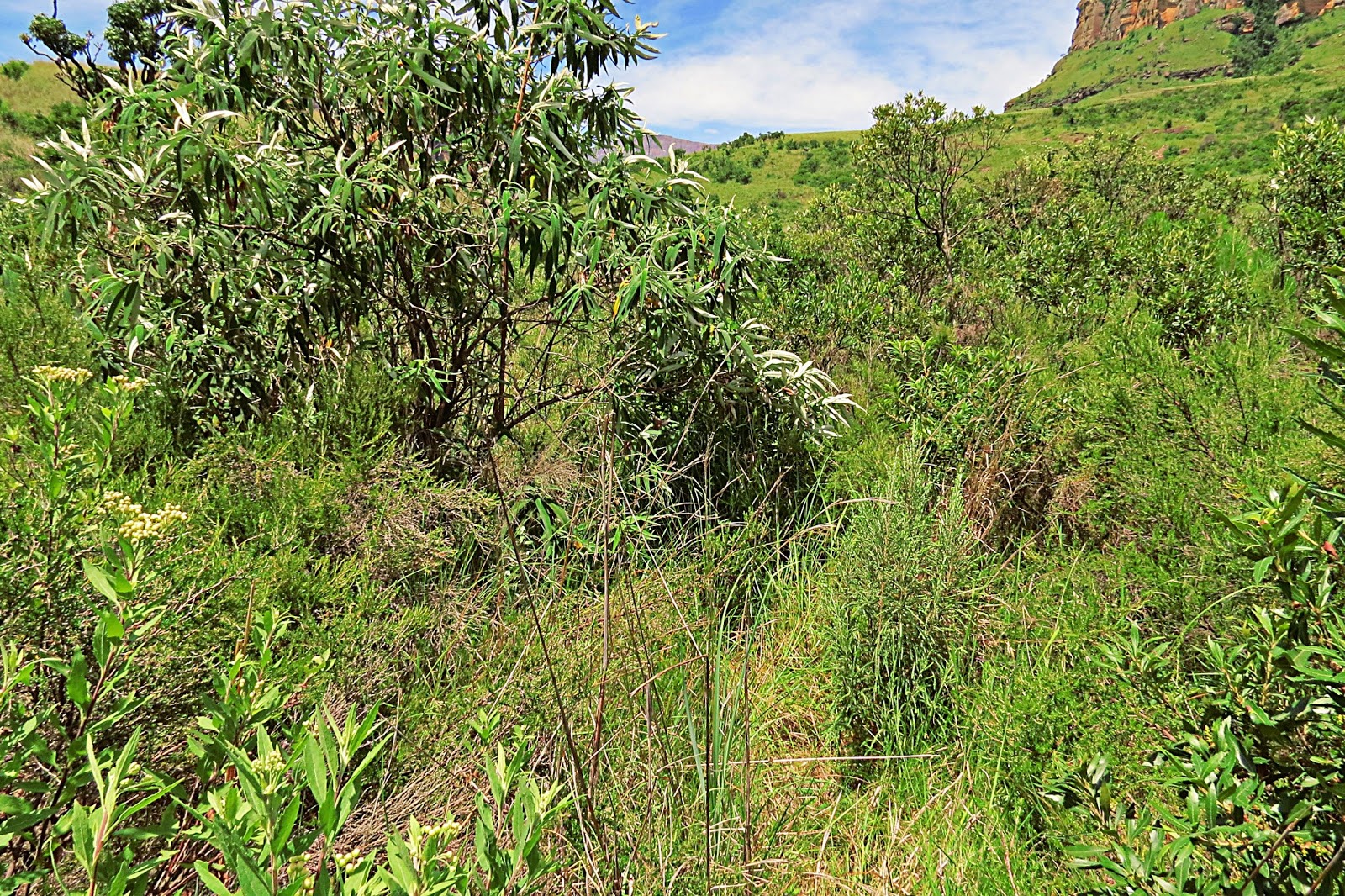
An open patch on my route downstream.
To cut a long story short it took me almost 40 minutes to cover the 200 meters, only when I got there did I see there was a much easier route directly from the road. Well you live and learn. (I hope).
The pool, there is an eddy just in front of the rock and a deep undercut under the rock and under the grassy bank. I got several takes by letting my fly drift right through to the tail of the pool and swing, but missed them. My problem was that although my nymph had a bead head and a few turns of lead wire it wasn't enough to get really deep enough, and my container of split-shot was lying at home.
A view upstream. Although the water was flowing very fast, there are plenty of nice holding spots. Against the far bank was a deep run with a nice undercut.
Cape Grass bird, (Sphenoeacus afer). I spotted this bird on my way out, habitat; rank grass-land. Well the grass here can be described as very rank.
Just another S#@t day in Africa.
Showing posts with label rainbow trout. Show all posts
Friday, 4 January 2013
Sunday, 11 March 2012
Fly fishing at Injasuthi.
Remembered my fly rod this time and all the other bits and pieces one has to take along to catch a fish. One thing has me beat though, and that is how do you carry your landing net? I've tried to attach it to the ring at the back of my fishing vest, stick the handle down between my day pack and my back, (not very comfortable) attach it the front of my fishing vest, to my belt, carry it in my hand, nothing works. The fine mesh hooks onto every, branch, twig, thorn bush and even blades of coarse grass.
Click on photos to enlarge.
Looking up the Injasuthi valley.
Tried this pool first, but had no luck. The water was crystal clear and my 4x tippet looked like a ships anchor cable in the clear water.
Drove down the road about 4km's and parked on the side. Made my way down to the river over some very rough terrain. The river is only about 50 meters to the right but one has to work your way a considerable distance upstream before it is possible to get through the thick bush along the banks and into the water.
All along the way there are these small streams of water that join the main river.
Another little stream.
After I got to the river I worked my way upstream until I got to this long deep pool. Although the water was just as clear here I was standing below the bank and not so visible against the sky line. After 10 minutes of fishing I shortened my leader and reduced my tippet to a 5x. Almost immediately I got fish attacking my size 14 stimulator. It was as if they were trying to drown it before taking it. I changed to a size 14 DDD, a spun deer hair dry fly which floated better in the rough water. Again lots of splashy rises, one fish even jumped right out of the water and onto the fly in an attempt to drown it.
Looked through my dry fly box and found a size 16 Humpy. This fly I had tied with CDC feathers instead of deer hair and a bright green body of floss. A few strands of antron for the tail under CDC, and a CDC wing. This fly immediately got serious attention, but my strikes were either to quick or too slow. (There's a thin line between too quick and too slow with dry flies).
But then a gentle sip, so slight I almost missed the take. This time I got the timing right and a feisty rainbow trout was giving me a run for my money, making full use of the strong current in it's efforts to get free. After a bit more than a minute I was able to land the exhausted fish. I held it in the water for about a minute so it could get it's "breath back", before posing it for a quick photo.
The fish had swallowed the fly quite deep but I had no problem removing the de-barbed hook with my forceps. Then I noticed that it was bleeding badly so I decided not to release it to die anyway, but killed it quickly. Now residing in my fridge and will make a nice breakfast.
Don't ask me how I got the fly line so tangled around the handle.
When I gutted the fish I saw that it was gravid with roe, the next generation of trout. More's the pity at having to kill it. Trout will start spawning in our rivers by May as winter sets in and water temperatures drop. Stream and river fishing for trout are closed from the 1st of May until the 1st of September. So I've got a bit more than a month's stream fishing left, then it's still water fishing for trout through the winter.
The weather had turned hot and sultry with huge banks of clouds massing over the Drakensberg. When I heard the first rumbling of thunder I decided to pack up. It does not pay to wave a long piece of carbon fibre around when there's thunder and lightning about.
.
Click on photos to enlarge.
Looking up the Injasuthi valley.
Tried this pool first, but had no luck. The water was crystal clear and my 4x tippet looked like a ships anchor cable in the clear water.
Drove down the road about 4km's and parked on the side. Made my way down to the river over some very rough terrain. The river is only about 50 meters to the right but one has to work your way a considerable distance upstream before it is possible to get through the thick bush along the banks and into the water.
All along the way there are these small streams of water that join the main river.
Another little stream.
After I got to the river I worked my way upstream until I got to this long deep pool. Although the water was just as clear here I was standing below the bank and not so visible against the sky line. After 10 minutes of fishing I shortened my leader and reduced my tippet to a 5x. Almost immediately I got fish attacking my size 14 stimulator. It was as if they were trying to drown it before taking it. I changed to a size 14 DDD, a spun deer hair dry fly which floated better in the rough water. Again lots of splashy rises, one fish even jumped right out of the water and onto the fly in an attempt to drown it.
Looked through my dry fly box and found a size 16 Humpy. This fly I had tied with CDC feathers instead of deer hair and a bright green body of floss. A few strands of antron for the tail under CDC, and a CDC wing. This fly immediately got serious attention, but my strikes were either to quick or too slow. (There's a thin line between too quick and too slow with dry flies).
But then a gentle sip, so slight I almost missed the take. This time I got the timing right and a feisty rainbow trout was giving me a run for my money, making full use of the strong current in it's efforts to get free. After a bit more than a minute I was able to land the exhausted fish. I held it in the water for about a minute so it could get it's "breath back", before posing it for a quick photo.
The fish had swallowed the fly quite deep but I had no problem removing the de-barbed hook with my forceps. Then I noticed that it was bleeding badly so I decided not to release it to die anyway, but killed it quickly. Now residing in my fridge and will make a nice breakfast.
Don't ask me how I got the fly line so tangled around the handle.
When I gutted the fish I saw that it was gravid with roe, the next generation of trout. More's the pity at having to kill it. Trout will start spawning in our rivers by May as winter sets in and water temperatures drop. Stream and river fishing for trout are closed from the 1st of May until the 1st of September. So I've got a bit more than a month's stream fishing left, then it's still water fishing for trout through the winter.
The weather had turned hot and sultry with huge banks of clouds massing over the Drakensberg. When I heard the first rumbling of thunder I decided to pack up. It does not pay to wave a long piece of carbon fibre around when there's thunder and lightning about.
.
Monday, 27 February 2012
Injasuthi River exploration 1.
After following the faint trail for about 200 meters I came to a natural sort of dyke covered with thick shrub and grass, struggling to the top this is what I saw.
Click on pictures to enlarge.
Looking upstream there is a nice long riffle leading out of a long deep pool. The zoom lens makes the pool look smaller than it is. Along the far end of the bank there is a thick fringe of reeds, almost looks like there could be a small spring tributary entering there. Then to the right there is a vertical bank of sandstone.
Above, looking downstream, a lovely run ending in some fast water. Not easy to get down to the water from this position, but I think if I could work my way downstream from here along the bank it might just be possible.
Photo above, detail of the pool in the first photo. The water almost has a glacial colour, one could imagine the rainbow trout of a lifetime lurking in it's depths.
Closer detail of the pool, zooming in on the far bank.
Then upstream of the pool, lovely pocket water. A nice big bouyant dry fly should do well here. Then again maybe a soft hackle, with short casts covering all the possible holding areas. Considering all the overhanging vegetation, terrestials such as hoppers and foam beetles could also work well here.
One would have to get into the water and wade as the bank is quite high and covered with dense growth. Wading will have to be done very carefully as the bottom of the stream is covered in loose boulders, from fist size to the size of a football. A wading staff will be essential.
A bit further upstream the fishing possibilities become even easier. Here the growth along the banks is not so dense so one could fish off the bank.
The stream stretches back all the way to the Drakensberg, with small tributaries joining it every couple of hundred metres. Some of these small tributaries really look as if they could hold fish. Here is enough fishable water, with enough challenges, to last one a life time.
.
Tuesday, 22 November 2011
Rainbow trout / Injasuthi stream.
Decided to try my luck this past Sunday, on the Injasuthi stream in the Injasuthi Nature Reserve, part of the Drakensberg wilderness area. The Injasuthi stream was stocked with rainbow trout more than a hundred years ago, so all the fish that you might catch here are wild trout. All the original rainbow trout ova came from the Kamloops area in Canada.
Well I'm almost starting to believe that I might still become a fly fisher one day, I managed to land four fish, loose several, and miss numerous takes.
Click on pictures to enlarge.
The road approaching the camp at Injasuthi. There are seventeen 6 sleeper chalets, two that sleep 8, and several camp sites, there are also several caves that can be booked further into the mountains. This area is favourite hiking and mountain climbing venue.
Injasuthi peaks visible in the gap, height about 3000m.
Final approach to the camp, the bridge in the middle foreground crosses the stream shown below.
One of the dozens of tributaries that flow into the Injasuthi river. The water here is safe to drink as is, needs no purification, is ice cold and absolutely delicious. These small streams also hold trout, small stream fly fishers dream.
The Injasuthi stream above, after a long drought reduced to a trickle. As unbelievable as it looks there a fish in that unlikely looking water. My first strike occurred just out of picture, upstream, in a pocket not much bigger than a kitchen sink.
Above first rainbow of the day, caught in the middle reaches of the pool below. What made it more enjoyable is that I caught it on a 2 weight, T F O, Finesse series rod, that I made up myself, from a blank, etc., ordered from J Stokard in the US. The fly was a #14 RAB that I tied a few days earlier. This was the first time that I'd used a RAB dry fly and I was most impressed. Lands like a feather and almost seems to dance on the water.
Tail end of the pool. Had several fish rise to my fly here, but turn away at the last second, them I noticed that the last bit of the 5x tippet was visible on the surface. Treated it with my home made degreaser, (Fullers earth mixed with dish washing liquid), problem over.
Same pool as above, but upstream. All the fish were holding in the main current against the far bank.
Second rainbow of the day, the RAB can still be seen in it's lip. This fish fought until it was quite exhausted. Took me a while to revive it and eventually swam away vigorously.
Third fish of the day. All the fish in pictures I see on other blogs seem to pose decorously for their picture, mine refuse to keep still, they flap and flop about, unwilling to pose. This one was in the middle of a flap as you can see.
I caught a fourth rainbow of about 3 inches, this little fish tried to bluff me he was a tuna.
To really enjoy the fishing here one needs to spend several days exploring the stream, there are many kilometers of fishable water, not counting the tributaries, so you need to camp there. Next project is to get a nice reliable tent, (sleeping bag and inflatable mattress I have), just a few other bits and pieces of camping equipment needed.
I have camped at Injasuthi twice in the past, both times I was rained out by torrential rain.
Saturday, 18 June 2011
Bracken Waters & Grantchester
Went trout fishing on Thursday and Friday. Thursday, June 16th is youth day in South Africa and a public holiday. Friday was a school holiday, thus I had a nice long weekend. A friend and ex teaching colleague came to visit from Durban and she wanted to learn how to fly fish. She arrived at about 14:30 Wednesday afternoon and after a quick cup of coffee we went onto the lawn and I started to teach her the basics of casting. What a pleasure to teach someone who is mentally and physically coordinated. It wasn't long before she had the hang of it. Women don't try to force their cast and just have natural rhythm and timing. After about an hour of practice we decided it was time for another cup of coffee and I gave her a simple book on casting so she could get the theory part. Maybe it should have been the other way round but then it would have been to dark to do any casting.
Thursday morning, after a hearty breakfast we took a slow drive to a dam/pond (In SA we also call the water behind the dam wall the dam) called Bracken Waters, a beautiful large stretch of water (about a kilometre wide and two kilometres long) to fish for rainbow trout. This dam has large mouth black bass and trout. I have fished this dam many times in summer for bass and the bass fishing is magnificent, with lots of large hungry bass. The club policy is that you have to remove all bass you catch to reduce their numbers, I find this hard to do, so I cheat a bit. Anyway this is such a large piece of very fertile water, with lots of structure and weed beds, that there must be thousands of bass. The few you might remove in a days fishing is not going to make much impact on their numbers. Further more, bass are active in summer and trout in winter. In summer trout will seek out the deeper cooler areas and bass will be looking for warmer waters. Trout fingerling's are only stocked in the cooler months so I don't think bass have much of an impact on their numbers.
This was the first time that I had fished this piece of water in winter for trout. When we got there the wind was blowing quite a gale, but otherwise a beautiful day, with blue sky and temperature about 15 degrees Celsius. I thought that my learner fly fisher woman would be put off by the wind, but she took it in her stride and started casting. Fortunately the wind was from behind and over our left shoulders which helped. Margaret turned out to be a great fishing buddy, no talking just concentrating on the task at hand, casting and retrieving, very slowly. She wanted no further assistance and I could get on with my fishing.
Well to cut a long story short the wind just about blew us off the dam wall and into the water. After about three hours we cut our losses and packed up with out even seeing a fish.
Next morning, which was Friday we went to a different stretch of water, Grantchester on Defence farm. This farm has a long history going back to about the 1840's, when it was established as an outpost to try and stop Bushmen stock theft. Bushmen living in the foothills of the Drakensberg used to pass through this area to raid farms lying lower down. Who settled on this farm originally I don't know, but he must have been a brave man.
Grantchester is a lovely piece of water, situated in a long narrow, steep sided valley, with deep water right on the side, except at the top end where the gradient is not so steep. Again this is a big piece of water about a kilometre + long and more than 500 metres wide at it's widest (at a guess) The wind was again blowing, but not as bad as the day before. I sent Margaret to the northern shore so that she could cast with the wind, and I stayed on the southern shore to fish into the wind.
For quite a while it was as if I could not get into my casting rhythm. After about a half hour of frustration I noticed that I had not threaded my line correctly through the third and second last guides, but that the line actually went over the top of the rod after the third last guide then though the second last guide the over the top again before going through the tip top! How I did that I still don't know, anyway I then corrected the problem and my casting improved, but still not one hundred percent. Then I noticed that I had not put the line through the stripping guide but through the gap between one of the supports and the guide. So off came the fly, pulled the line out and re threaded it once again.
Now my casting was normal and I managed to get a reasonable distance against the wind. Then the moment all fly fishers wait for, a solid strike and fish on. Once the fish felt the hook it headed down into the depths, taking line. When it stopped I retrieved line, the fish headed for the surface and jumped doing cartwheels before landing with a splash, still on. I shouted to Margaret on the opposite shore, "This ones headed for the frying pan." After a couple of minutes I managed to bring it in quite close and could see it about a metre down. It was a big one at least 2 1/2 pounds or more. The fish made one more run for deep water, then the unthinkable happened. The tippet parted from the leader at the knot. To say I was disappointed would be an understatement, my first trout of the season and I lost it. My vocabulary at that moment would have made a sailor blush, and I'm not a man who swears.
Well I tied on a new tippet and another wiggle tail. By now the wind had changed direction and was blowing from the east down the length of the water, and blowing a gale. I crossed over on the dam wall to the northern shore. Here the gradient is very steep and the bank drops away right into deep water. When I got there Margaret was very excited, saying that she had seen lots of fish and they even followed her fly right to the side before suddenly turning away. She also had a wiggle tail on.
I cast and let the fly sink the whole length of the 3 metre leader plus another 1/2 metre tippet, then I slowly lifted my rod making the fly rise to the surface, just before I lifted the fly off the water a trout shot up from the depths a grabbed it. Before I could react it spat it out and was gone. This happened several times and I had several seemingly solid takes only to have the fish shake out the hook. By now the wind was sending waves crashing against the bank and conditions were becoming very unpleasant and casting almost impossible. So we called it a day.
Well I'm a wiggle tail fly fan and I'm busy tying a whole bunch of them in black, brown and olive.
And Margaret has been hooked by fly fishing and wants to come again in July.
I took quite a few photos of both stretches of water and surrounding area, but for some reason I can't download them from my camera onto the computer. Which is strange because 2 days ago I downloaded several photos. As soon as I've sorted out this problem I'll post them.
Thursday morning, after a hearty breakfast we took a slow drive to a dam/pond (In SA we also call the water behind the dam wall the dam) called Bracken Waters, a beautiful large stretch of water (about a kilometre wide and two kilometres long) to fish for rainbow trout. This dam has large mouth black bass and trout. I have fished this dam many times in summer for bass and the bass fishing is magnificent, with lots of large hungry bass. The club policy is that you have to remove all bass you catch to reduce their numbers, I find this hard to do, so I cheat a bit. Anyway this is such a large piece of very fertile water, with lots of structure and weed beds, that there must be thousands of bass. The few you might remove in a days fishing is not going to make much impact on their numbers. Further more, bass are active in summer and trout in winter. In summer trout will seek out the deeper cooler areas and bass will be looking for warmer waters. Trout fingerling's are only stocked in the cooler months so I don't think bass have much of an impact on their numbers.
This was the first time that I had fished this piece of water in winter for trout. When we got there the wind was blowing quite a gale, but otherwise a beautiful day, with blue sky and temperature about 15 degrees Celsius. I thought that my learner fly fisher woman would be put off by the wind, but she took it in her stride and started casting. Fortunately the wind was from behind and over our left shoulders which helped. Margaret turned out to be a great fishing buddy, no talking just concentrating on the task at hand, casting and retrieving, very slowly. She wanted no further assistance and I could get on with my fishing.
Well to cut a long story short the wind just about blew us off the dam wall and into the water. After about three hours we cut our losses and packed up with out even seeing a fish.
Next morning, which was Friday we went to a different stretch of water, Grantchester on Defence farm. This farm has a long history going back to about the 1840's, when it was established as an outpost to try and stop Bushmen stock theft. Bushmen living in the foothills of the Drakensberg used to pass through this area to raid farms lying lower down. Who settled on this farm originally I don't know, but he must have been a brave man.
Grantchester is a lovely piece of water, situated in a long narrow, steep sided valley, with deep water right on the side, except at the top end where the gradient is not so steep. Again this is a big piece of water about a kilometre + long and more than 500 metres wide at it's widest (at a guess) The wind was again blowing, but not as bad as the day before. I sent Margaret to the northern shore so that she could cast with the wind, and I stayed on the southern shore to fish into the wind.
For quite a while it was as if I could not get into my casting rhythm. After about a half hour of frustration I noticed that I had not threaded my line correctly through the third and second last guides, but that the line actually went over the top of the rod after the third last guide then though the second last guide the over the top again before going through the tip top! How I did that I still don't know, anyway I then corrected the problem and my casting improved, but still not one hundred percent. Then I noticed that I had not put the line through the stripping guide but through the gap between one of the supports and the guide. So off came the fly, pulled the line out and re threaded it once again.
Now my casting was normal and I managed to get a reasonable distance against the wind. Then the moment all fly fishers wait for, a solid strike and fish on. Once the fish felt the hook it headed down into the depths, taking line. When it stopped I retrieved line, the fish headed for the surface and jumped doing cartwheels before landing with a splash, still on. I shouted to Margaret on the opposite shore, "This ones headed for the frying pan." After a couple of minutes I managed to bring it in quite close and could see it about a metre down. It was a big one at least 2 1/2 pounds or more. The fish made one more run for deep water, then the unthinkable happened. The tippet parted from the leader at the knot. To say I was disappointed would be an understatement, my first trout of the season and I lost it. My vocabulary at that moment would have made a sailor blush, and I'm not a man who swears.
Well I tied on a new tippet and another wiggle tail. By now the wind had changed direction and was blowing from the east down the length of the water, and blowing a gale. I crossed over on the dam wall to the northern shore. Here the gradient is very steep and the bank drops away right into deep water. When I got there Margaret was very excited, saying that she had seen lots of fish and they even followed her fly right to the side before suddenly turning away. She also had a wiggle tail on.
I cast and let the fly sink the whole length of the 3 metre leader plus another 1/2 metre tippet, then I slowly lifted my rod making the fly rise to the surface, just before I lifted the fly off the water a trout shot up from the depths a grabbed it. Before I could react it spat it out and was gone. This happened several times and I had several seemingly solid takes only to have the fish shake out the hook. By now the wind was sending waves crashing against the bank and conditions were becoming very unpleasant and casting almost impossible. So we called it a day.
Well I'm a wiggle tail fly fan and I'm busy tying a whole bunch of them in black, brown and olive.
And Margaret has been hooked by fly fishing and wants to come again in July.
I took quite a few photos of both stretches of water and surrounding area, but for some reason I can't download them from my camera onto the computer. Which is strange because 2 days ago I downloaded several photos. As soon as I've sorted out this problem I'll post them.
Saturday, 30 April 2011
Boomy dam
Decided this morning to take a trip to Boomy Dam in the Kamberg Valley. Boomy Dam is one of the Natal Fly Fishers Club waters, stocked with rainbow trout. The NFFC stocks the dams with very small trout, from 2 to 4 inches, up to 1500 at a time, the attrition rate is high, only the fittest survive. So though they are not wild bred, they soon become feral, definitely not stockies. These dams are extremely fertile and trout grow big.
From my cottage to the dam +- 62km, half of this on 4 lane highway. Packed lunch, some biltong (jerky), crisps, energy bars and juice.
The Kamberg valley has intensive farming, dairy, beef, maize and fodder crops for cattle. Over the years farmers have built thousands of dams, most of these dams are stocked with trout. The NFFC has access to about 30 of these dams plus rivers and streams in the valley. The most famous of these streams is the Mooi and the Little Mooi, home to brown trout. Mooi means pretty, and they are pretty.
Entrance to Boomy Dam, all NFFC waters are on private property so all gates must be closed. Farm gates have a mind of their own, a sadistic mind.
A grove of pin oaks on the edge of Boomy dam, the leaves are starting to get their autumn tint.
If you enlarge this photo you will see between the dead tree on the left and the pin oaks on the right the Kamberg, kam, Afrikaans for comb. The mountain is long, narrow and steep sided with a slightly serrated edge and side on it looks a bit like a comb, thus Kamberg, or comb mountain.
Opposite side of the road an avenue of pin oaks and behind them Goose dam, also NFFC waters, different land owner. In this area of about 4 square kilometres there are six NFFC dams.
Partial view of goose dam. There is a steep drop-off on the far side into deep water, caught some big rainbows there in the past. There were two fly-fishers on float tubes on this water hidden behind the branches on the left.
Glimpse of Boomy dam.
Rod set up, fly-vest hanging from the back door and breakfast on the roof.
Breakfast and fly box, rod on the right.
About 300 + metres to the other side. All this water to myself. The day was slightly overcast to start with.
View from the opposite bank. Car parked under those trees across the dam. In South Africa the term dam does not only apply to the wall off the dam but the water behind it. This dam/pond is several acres in size and has provided some trophy sized rainbows. I have never been very lucky here but I love fishing here because of it's beautiful setting. Next time I come I'll bring my float tube, love fishing from a float tube, like sitting in a armchair.
Today was no different and I caught nothing, even used a big olive and brown woolly bugger. The water was very murky and visibility was a few inches, but I enjoyed myself anyway. Today would have been a good day for a bunch of worms on a hook, but totally "verboten" on these waters. In South Africa you may not use bait to catch trout, only flies.
If you click on this photo to enlarge you might just see the Cape vultures circling over the trees trying to find a thermal. The young farmer on the farm behind the trees has a vulture restaurant, and farmers bring dead livestock and leave it on the hill. Without vulture restaurants vultures would starve, farmers don't like leaving dead animals lying round.
In spite of plastering myself with SPF 60 sun block the sun cooked me to a frazzle after fiver hours, so I went home, a day well spent.
From my cottage to the dam +- 62km, half of this on 4 lane highway. Packed lunch, some biltong (jerky), crisps, energy bars and juice.
The Kamberg valley has intensive farming, dairy, beef, maize and fodder crops for cattle. Over the years farmers have built thousands of dams, most of these dams are stocked with trout. The NFFC has access to about 30 of these dams plus rivers and streams in the valley. The most famous of these streams is the Mooi and the Little Mooi, home to brown trout. Mooi means pretty, and they are pretty.
A grove of pin oaks on the edge of Boomy dam, the leaves are starting to get their autumn tint.
If you enlarge this photo you will see between the dead tree on the left and the pin oaks on the right the Kamberg, kam, Afrikaans for comb. The mountain is long, narrow and steep sided with a slightly serrated edge and side on it looks a bit like a comb, thus Kamberg, or comb mountain.
Opposite side of the road an avenue of pin oaks and behind them Goose dam, also NFFC waters, different land owner. In this area of about 4 square kilometres there are six NFFC dams.
Partial view of goose dam. There is a steep drop-off on the far side into deep water, caught some big rainbows there in the past. There were two fly-fishers on float tubes on this water hidden behind the branches on the left.
Glimpse of Boomy dam.
Rod set up, fly-vest hanging from the back door and breakfast on the roof.
Breakfast and fly box, rod on the right.
About 300 + metres to the other side. All this water to myself. The day was slightly overcast to start with.
View from the opposite bank. Car parked under those trees across the dam. In South Africa the term dam does not only apply to the wall off the dam but the water behind it. This dam/pond is several acres in size and has provided some trophy sized rainbows. I have never been very lucky here but I love fishing here because of it's beautiful setting. Next time I come I'll bring my float tube, love fishing from a float tube, like sitting in a armchair.
Today was no different and I caught nothing, even used a big olive and brown woolly bugger. The water was very murky and visibility was a few inches, but I enjoyed myself anyway. Today would have been a good day for a bunch of worms on a hook, but totally "verboten" on these waters. In South Africa you may not use bait to catch trout, only flies.
If you click on this photo to enlarge you might just see the Cape vultures circling over the trees trying to find a thermal. The young farmer on the farm behind the trees has a vulture restaurant, and farmers bring dead livestock and leave it on the hill. Without vulture restaurants vultures would starve, farmers don't like leaving dead animals lying round.
In spite of plastering myself with SPF 60 sun block the sun cooked me to a frazzle after fiver hours, so I went home, a day well spent.
Thursday, 7 April 2011
Scenes from my area
This is the Wagendrift dam on the Bushmans river just outside Estcourt and about 4km from where I live. The lake behind the dam is a favourite water-sport and fishing area. Fish in the dam include, largemouth black bass, carp, Natal yellowfish, sharptooth catfish, (barbel), tilapia, and I think bluegill.
The curve of the dam wall is so pronounced that you can stand behind the curtain of water as the dam overflows. There is a special walkway to walk on.
A stretch of the eLotheni river in the Lotheni nature reserve. This is a brown trout stream and is about 90km, on mostly good roads, from my home.
Upper reaches of the Tugela river with the Amphitheatre area of the Drakensberg in the background.
Injasuthi valley with the Injasuthi river flowing through it, home to rainbow trout.
Just be glad you don't have to travel this road below to work everyday. Not much traffic but you need nerves of steel.
This is the Sani pass between KZN and Lesotho. This pass climbs 1330 metres,more than 4000 feet, in 6.5km, about 4 miles. Only 4x4 vehicles allowed on this road. In winter it is often closed due to ice and snow. The highest hotel in Africa is at the top of the pass, Sani Tops Hotel.
The Drakensberg in the Sani Pass area.
Another view of the pass, note the hairpin beds.
Enjoy.
The curve of the dam wall is so pronounced that you can stand behind the curtain of water as the dam overflows. There is a special walkway to walk on.
Upper reaches of the Tugela river with the Amphitheatre area of the Drakensberg in the background.
Injasuthi valley with the Injasuthi river flowing through it, home to rainbow trout.
Just be glad you don't have to travel this road below to work everyday. Not much traffic but you need nerves of steel.
This is the Sani pass between KZN and Lesotho. This pass climbs 1330 metres,more than 4000 feet, in 6.5km, about 4 miles. Only 4x4 vehicles allowed on this road. In winter it is often closed due to ice and snow. The highest hotel in Africa is at the top of the pass, Sani Tops Hotel.
The Drakensberg in the Sani Pass area.
Another view of the pass, note the hairpin beds.
Enjoy.
Subscribe to:
Posts (Atom)