Nguni cattle arrived in Southern Africa about nine hundred, or more, years ago with the arrival of the Nguni people, Swazi, Zulu and Xhosa. A truly indigenous breed. The cattle below are not pure bred, but there is something in their colouring, horns and shape of the head that is very distinctive of them.
Nguni bull in the foreground.
During the days of the old Zulu kings, Shaka, Dingane and Cetswayo, nguni cattle were selectively bred for the colour and patterns on their hides. Each Zulu regiment had it's own distinctively coloured shield, six foot high and about three feet wide at it's widest. The shield would cover the whole body of the warrior.
The shield was used more as an offensive weapon than a means of protection. A Zulu warrior was trained to use the left edge of his shield to pull away the left edge of the enemies shield, leaving the left armpit open for a killing thrust into the heart.
Nguni cow, this time brindle in colouring. In the days of the old Zulu Kings, all white cattle were the property of the King, who had huge herds of pure white cattle. *Africans don't need brands to identify their cattle, they can tell at a glance, which is theirs among hundreds of others They know their animals the way we know our pets.
Commercial farmers are beginning to value the unique qualities of Nguni cattle. They are hardy, very resistant to tick borne diseases, and survive in conditions where fancier breeds don't stand a chance.
In both pictures you can see Sissie, she is actually very scared of cattle but believes she must face her fears by attacking them, not that she makes much impression on them. Nguni cattle are used to dogs and people and except for an irritable stamp of a hoof, mostly just ignored her.
*The law today, though, says that every cattle owner must brand his animals with a registered brand, this is to combat theft.
Showing posts with label Zulu. Show all posts
Saturday, 10 September 2011
Friday, 10 June 2011
House keeper
Being a bachelor has some drawbacks, one being the inevitable slide into, well, one could almost say barbarism as far as the state of ones home goes. A women's main job in life is to civilize her man. Not having one to do this for me, I was well on the way to a very barbaric home life when Mrs Maria Zuma crossed my path.
Click on photo to enlarge.
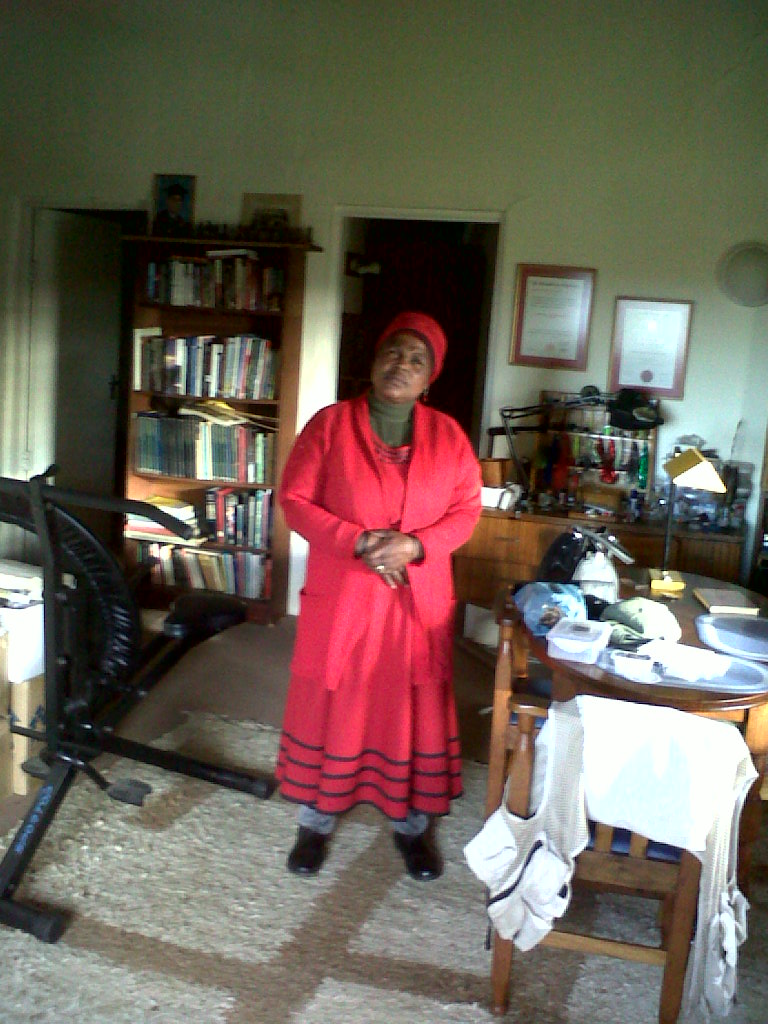
Took this picture of Maria this afternoon as she was preparing to leave, used my cell phone and she was unaware that I was photographing here, hence the puzzled look on her face when I called her. When she saw her photo she let out a indignant "HAUW" a word Zulus use when they are not happy with something. Told me in no uncertain terms that if she knew she was been photographed she would have smiled. Then she laughed at the fact that she was dressed totally in red. I told she looked very smart which pleased her no end. Women are all the same, just notice what they are wearing, compliment them, and they are happy.
As you can see by the fly fishing vest hanging over the chair, exercise machine, etc., Maria has not quite succeeded in her civilizing mission with this bachelor.
Maria started working for me 10 years ago while I was living on a farm 20km north of Estcourt near a small village called Frere. Her aunt asked me if I would not employ her as the family were having a hard time financially. At the time I was not in a much better position being self employed and living on a shoe string. We came to an agreement that she would work for me in the garden at R10 a day, little more than $1,(you can't buy much more than a couple of loaves's of bread with that). I would supply seed, fertilizer and gardening tools, she would do the work, we would split the income from the garden 50/50, and she could take vegetables home. Soon there was a flourishing garden and the locals were queuing up to buy the produce.
Before I knew it Maria was running my home too, cooking, washing, ironing and cleaning.
Maria keeps complaining about fact that we don't have a vegetable garden here.
Maria is married with four children. Her husband Sipho is a very dignified looking man with a deep voice and a slow deliberate way of talking. He has decided that he is too old to work, (he is a long way from 60). Her oldest son Mondli is slightly retarded, due to a long and difficult birth. I helped her get a disability grant for him, which immediately put the family on a positive economic footing, (this is when Sipho decided he was too old to work).
Sibonelo is the second eldest son, and his mother pride and joy. Sibonelo is a long distance truck driver. He also supports the family financially and buys such things as refrigerator's, TV's and other luxuries for the home.
When things were financially difficult for the family, Sibonelo went to live with an uncle in Durban who, fed, clothed him, and paid his school fees. When he came home to Frere for the school holidays, he would come and visit me. He would greet me in Zulu "Sawubono Nkozana". Which means I see you sir. We would enquire about each others health, how his school work was going, etc. I would fetch him a cool drink and a snack, then he would sit on the floor floor at my knee for an hour or more not saying anything. Then as quietly as he came he would get up and greet me in Zulu, "Salle kahle Nkozana, which means stay well, and leave. This happened every holiday. Today he is a grown man and he at least agrees to sit on a chair, he is still as quiet as ever though.
Then there is a daughter, Gugu, who is studying catering and hospitality management, who wants to follow a career in tourism. Lastly is the youngest so S'Ne (short for S'Nenhlanhla) who is in grade 10. A quiet well behaved boy who's only concession to being a teenager is a small gold stud in his left ear. He is also a very snazzy dresser. S'Ne wants be a truck driver like his big brother.
Maria is a very intelligent woman, but she has had very little education and can speak no English. My Zulu has improved by leaps and bounds since she has worked for me. Maria works three days a week for me, while she is here she has her radio on Nkozi FM, the Zulu radio station. So the only news I hear is in Zulu, improving my Zulu still more.
As my financial position improved so has my ability to pay her, she now earns much more than R10 a day, I also pay her taxi fare to and from work. Maria has been such a blessing to me that whatever I pay her won't be enough. More like a sister to me than a servant, and although she is younger than me, sometimes a mother. She often reminds me not to worry too much about this life, because in our Fathers house there are many mansions waiting for us.
Click on photo to enlarge.
Took this picture of Maria this afternoon as she was preparing to leave, used my cell phone and she was unaware that I was photographing here, hence the puzzled look on her face when I called her. When she saw her photo she let out a indignant "HAUW" a word Zulus use when they are not happy with something. Told me in no uncertain terms that if she knew she was been photographed she would have smiled. Then she laughed at the fact that she was dressed totally in red. I told she looked very smart which pleased her no end. Women are all the same, just notice what they are wearing, compliment them, and they are happy.
As you can see by the fly fishing vest hanging over the chair, exercise machine, etc., Maria has not quite succeeded in her civilizing mission with this bachelor.
Maria started working for me 10 years ago while I was living on a farm 20km north of Estcourt near a small village called Frere. Her aunt asked me if I would not employ her as the family were having a hard time financially. At the time I was not in a much better position being self employed and living on a shoe string. We came to an agreement that she would work for me in the garden at R10 a day, little more than $1,(you can't buy much more than a couple of loaves's of bread with that). I would supply seed, fertilizer and gardening tools, she would do the work, we would split the income from the garden 50/50, and she could take vegetables home. Soon there was a flourishing garden and the locals were queuing up to buy the produce.
Before I knew it Maria was running my home too, cooking, washing, ironing and cleaning.
Maria keeps complaining about fact that we don't have a vegetable garden here.
Maria is married with four children. Her husband Sipho is a very dignified looking man with a deep voice and a slow deliberate way of talking. He has decided that he is too old to work, (he is a long way from 60). Her oldest son Mondli is slightly retarded, due to a long and difficult birth. I helped her get a disability grant for him, which immediately put the family on a positive economic footing, (this is when Sipho decided he was too old to work).
Sibonelo is the second eldest son, and his mother pride and joy. Sibonelo is a long distance truck driver. He also supports the family financially and buys such things as refrigerator's, TV's and other luxuries for the home.
When things were financially difficult for the family, Sibonelo went to live with an uncle in Durban who, fed, clothed him, and paid his school fees. When he came home to Frere for the school holidays, he would come and visit me. He would greet me in Zulu "Sawubono Nkozana". Which means I see you sir. We would enquire about each others health, how his school work was going, etc. I would fetch him a cool drink and a snack, then he would sit on the floor floor at my knee for an hour or more not saying anything. Then as quietly as he came he would get up and greet me in Zulu, "Salle kahle Nkozana, which means stay well, and leave. This happened every holiday. Today he is a grown man and he at least agrees to sit on a chair, he is still as quiet as ever though.
Then there is a daughter, Gugu, who is studying catering and hospitality management, who wants to follow a career in tourism. Lastly is the youngest so S'Ne (short for S'Nenhlanhla) who is in grade 10. A quiet well behaved boy who's only concession to being a teenager is a small gold stud in his left ear. He is also a very snazzy dresser. S'Ne wants be a truck driver like his big brother.
Maria is a very intelligent woman, but she has had very little education and can speak no English. My Zulu has improved by leaps and bounds since she has worked for me. Maria works three days a week for me, while she is here she has her radio on Nkozi FM, the Zulu radio station. So the only news I hear is in Zulu, improving my Zulu still more.
As my financial position improved so has my ability to pay her, she now earns much more than R10 a day, I also pay her taxi fare to and from work. Maria has been such a blessing to me that whatever I pay her won't be enough. More like a sister to me than a servant, and although she is younger than me, sometimes a mother. She often reminds me not to worry too much about this life, because in our Fathers house there are many mansions waiting for us.
Subscribe to:
Posts (Atom)