It was cold this morning, really cold, even the tough guys were wearing coats and scarves to church. In front of me though sat an Indian teenager dressed in shirt sleeves, no coat or anything. The rest of his family were all covered up to their ears. I had to ask him, "aren't you cold?". No he wasn't cold and he seemed quite comfortable. I was frozen and my hands and feet were like ice, still are like ice. Some people just don't seem to feel the cold, my brother wears shorts winter and summer, when he wears long pants then you know it's cold.
The cold is not what I wanted to talk about, but I had to mention it and get it off my chest.
There are less than fifty countries in the World where any form of religious freedom exists. These freedoms are being restricted more and more, with Christianity bearing the brunt of these restictions. Even in the so called, or maybe what used to be Christian West, these freedoms are being restricted. In these countries though, you can still go to church, convert to another religion without penalties or persecution and believe as your conscience leads you. In Islamic countries religious freedom does not exist.
In our church bulletin this morning was a piece about a Christian pastor in Iran who has been sentenced to death for apostasy.
Pastor Yousef, who is a pastor in the Full Gospel Church of Iran, was arrested on the 12 October, 2009 and charged with apostasy. On the 21 & 22 September, 2010 he was found guilty and sentenced to death. He appealed to the supreme court ,which rejected his appeal and confirmed the death sentence on 22 June 2011. Pastor Yousef has a wife and two children.
Pastor Yousef's execution has been delayed to give him time to "repent" of his Christian faith.
Pray for Pastor Yousef. Link to Middle East Concern for more on this.
http://www.meconcern.org/cgi-bin/giga.cgi?cmd=cause_dir_news_item&news_id=97308&cause_id=1489
Sunday, 10 July 2011


Thursday, 7 July 2011
Forgotten Heroes
Yesterday I took a trip to Clouston Garden of Remembrance, about 30km north of Estcourt, and 5km from the small town of Colenso on the Tugela river. British troops who fell during the Battle of Colenso 15th December, 1899, were reburied here in the early 1960's. Originally the troops were buried where they fell, singly or in groups. Virtually every town and village in South Africa has British troops buried nearby or in the old cemetary. Now forgotten, not many people know about them except Anglo/Boer War history buffs.
On the 15th of December 1899, British forces, numbering about, 18,000 men, under General Buller's command attacked about 4,500 Boer troops ensconced in the hills north of the Tugela river. This was an attempt to relieve the beseiged British garrison in Ladysmith. By the end of the day British casualties were, 145 dead, 762 wounded, and 220 missing or prisoners. Boer casualties were minimal.
The Anglo/Boer war led to three years of intense and unnecessary suffering. Concentration camps cost the lives of 26,000 Boer women and children, about 20, 000 black South Africans also died in concentration camps, official British figures are about 14,500. British casualties were, 28,000 dead, about 20,000 of whom died of disease. About 450,000 British and Empire, (Australia, New Zealand and Canada) troops were deployed in South Africa. Boer casualties were about 4000 killed. Boer forces never had more than 40,000 troops in the field at any one time, in the last half of the war this number dropped to about 20,000.
Link to piece on concentration camps
.http://www.google.co.za/search?q=anglo+boer+war+concentration+camps&hl=en&biw=1024&bih=679&prmd=ivns&tbm=isch&tbo=u&source=univ&sa=X&ei=2PEVTqiMDaPgmAXG_7Ug&ved=0CEEQsAQ

Entrance to Clouston. The garden of remembrance is maintained by the National Monuments Commission.

They died together, they're buried together.
 Another nameless grave.


Pvt. Ford of the 14th Hussars at least had his name recorded, the two on either side of him are nameless.
 Graves in the shade of an African thorn tree. If things had been different their graves would have been under an English oak, somewhere in England.

This marker, "Known only unto God," between the two graves above
 Peaceful setting.
 Most British troopers just have the markers above to mark their graves, no name.

Above two comrades of the Natal Carbineers Regiment. Both drowned in the Tugela river, one trying to save the other. The Anglo/Boer War has also been described as a civil war, the name on the right hand tombstone is Boshoff, a well known Boer name, fighting on the British side.
 Lt. Freddy Roberts, VC. Son of General Roberts, wounded while trying to save the guns at Colenso. It took three days for him to die of an abdominal wound. General Roberts received news of his sons death as he was boarding ship for South Africa, to take over command of the British forces.
 This markers tells it's own story.

Gunners badge.
 Natal Carbineers Monument.
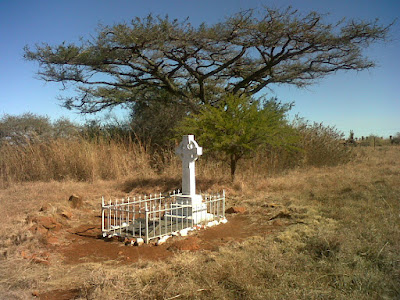 Lonely grave in the African veld of Capt. M. L. Hughes, R.A.M.C. Aged 30.

The waste of war. Marker at the foot of Captain Hughes' grave.
 Photo above shows the ground the British forces had to cross before reaching the Tugela river at the foot of the hills on the north bank. Boer forces had a clear view of their every move. December being the rainy season the river was in flood, with only a few places where it could be crossed.

 Partial view over the Garden of Remembrance. Wandering about I found the atmosphere very peaceful and quite. All the anger and hatred had been spent and dissipated over the last 100 years.
This link below has a complete article on this battle.
http://www.historyofwar.org/articles/battles_colenso.html
The Wikipedia link below gives a broad overview of the Anglo/Boer War,
http://en.wikipedia.org/wiki/Second_Boer_War
On the 15th of December 1899, British forces, numbering about, 18,000 men, under General Buller's command attacked about 4,500 Boer troops ensconced in the hills north of the Tugela river. This was an attempt to relieve the beseiged British garrison in Ladysmith. By the end of the day British casualties were, 145 dead, 762 wounded, and 220 missing or prisoners. Boer casualties were minimal.
The Anglo/Boer war led to three years of intense and unnecessary suffering. Concentration camps cost the lives of 26,000 Boer women and children, about 20, 000 black South Africans also died in concentration camps, official British figures are about 14,500. British casualties were, 28,000 dead, about 20,000 of whom died of disease. About 450,000 British and Empire, (Australia, New Zealand and Canada) troops were deployed in South Africa. Boer casualties were about 4000 killed. Boer forces never had more than 40,000 troops in the field at any one time, in the last half of the war this number dropped to about 20,000.
Link to piece on concentration camps
.http://www.google.co.za/search?q=anglo+boer+war+concentration+camps&hl=en&biw=1024&bih=679&prmd=ivns&tbm=isch&tbo=u&source=univ&sa=X&ei=2PEVTqiMDaPgmAXG_7Ug&ved=0CEEQsAQ

Entrance to Clouston. The garden of remembrance is maintained by the National Monuments Commission.

They died together, they're buried together.


Pvt. Ford of the 14th Hussars at least had his name recorded, the two on either side of him are nameless.


This marker, "Known only unto God," between the two graves above


Above two comrades of the Natal Carbineers Regiment. Both drowned in the Tugela river, one trying to save the other. The Anglo/Boer War has also been described as a civil war, the name on the right hand tombstone is Boshoff, a well known Boer name, fighting on the British side.


Gunners badge.


The waste of war. Marker at the foot of Captain Hughes' grave.


This link below has a complete article on this battle.
http://www.historyofwar.org/articles/battles_colenso.html
The Wikipedia link below gives a broad overview of the Anglo/Boer War,
http://en.wikipedia.org/wiki/Second_Boer_War
Tuesday, 5 July 2011
Happiness hypothesis (Afluenza)
Afluenza. A term coined to denote the social ills caused by too much prosperity. Strange that intellectuals find it strange that "things", and lots of money don't bring happiness with it as a natural consequence. Rich is better than being poor, right?
Basically the conclusion of the piece is that people with religious affiliations are more contented with life, seem to live longer, and keep all their marbles longer.
I copied this piece from the following link.
http://www.religionandsociety.org.uk/uploads/docs/2009_12/1259854421_Graham_2009_article.pdf
Religion and the Pursuit of Happiness
So far we have focused on the importance of ‘valuing values’ in relation to happiness and well-being, and the need to incorporate into economic reckonings of prosperity a ‘thick’ account of human flourishing that acknowledges emotional, familial and spiritual factors, and is capable of understanding how religious values might contribute to well-being. What the literature on well being acknowledges time after time is the significance of a philosophy of life, although this is not identical with organized religion—even though Layard at one point does indeed declare that ‘people who believe in God are happier’.15 The Centre for Spirituality, Theology and Health at Duke University in the United States publishes digests of research in this area, and reports on a series of clinical studies which suggest, amongst other things: improved rates of recovery for cancer patients who report involvement in faith communities; enhanced longevity amongst those who attend synagogue; slower rates of cognitive decline in those experiencing the onset of dementia and marginal impact on aspects of coping strategies in relation to recovery from serious illness for 14)
Joseph Stiglitz, ‘h e Ethical Economist’, Foreign Affairs (November-December 2005), <http://
www.foreignaff airs.org/20051101farevieessay84612/joseph-e-stiglitz/the-ethical-economist.
html> [accessed 15 June 2008].15) Layard, Happiness, p. 72.12 E. Graham / International Journal of Public Theology 3 (2009) 5–23 religious people.16 The evidence is varied, but rich, although clearly such research raises important questions of method and interpretation. For example, is the incidence of better mental health amongst religious people due to divine influence or human solidarity; do different religious traditions deliver different degrees of well-being; what about religious traditions that stress individual practices, such as meditation, in comparison with more corporate ones; what is the relationship between ‘religion’ and spirituality’, that is between organizational, formal dimensions of observance and a more subtle appreciation of existential or transcendent dimensions to life. In terms of explaining the correlation between religion and well-being, however, the consensus seems to be that there is powerful ‘added value’ in religion.17 It appears to be down to a combination of factors, amongst which social support and membership of a faith-community is pre-eminent, but which extends to other forms of religious practice, such as prayer, reading one’s sacred Scriptures, a sense of meaning, an existential belief system and a well-articulated moral code. Whilst other (secular) activities might provide some of these elements, commentators such as Richard Eckersley, argue that religion ‘packages’ these components effectively and accessibly. 18 More specifi cally, John Swinton postulates various tangible mechanisms by which religious affiliation might contribute to greater mental and emotional well-being including: regulation of lifestyle and behaviour, such as restriction of intake of alcohol; provision of resources, such as social support and networks; promotion of positive self-esteem; acquisition of specific life-skills and coping resources, such as a framework of understanding illness, stress or loss; generation of positive emotions, cultivation of disposition towards forgiveness, hope and transformation. 19 Eckersley states: ‘All in all, well-being comes from being connected and engaged, from being suspended in a web of relationships and interests. h is gives meaning to people’s lives’.20
16)
‘Latest Religion and Health Research Outside Duke (2000–2007)’, <http://www.dukespirituality
andhealth.org/resources/pdfs/Research%20-%20latest%20outside%20Duke.pdf> [accessed 8 July
2008].
17)
Ibid.
18)
Richard M. Eckersley, ‘Culture, Spirituality, Religion and Health: Looking at the Big Picture’, Medical Journal of Australia, 186:10 (suppl.), 54–6.
19)
John Swinton, ‘Researching Spirituality and Mental Health’, in M. E. Coyte, P. Gilbert and
V. Nicholls, eds, Spirituality, Values and Mental Health (London: Jessica Kingsley Publishers,
2007), pp. 292–305.
20)
Eckersley, 54. E. Graham / International Journal of Public Theology 3 (2009) 5–23 13
These claims veer towards the territory of religion as a form of ‘social capital’. The danger of all of this, however, is to fall into a narrowly functionalist account, in which religion ‘delivers’ certain social goods to wider society. This is certainly one of the ways in which the ‘social capital’ thesis can be adopted,
but it seems to me that there are broader, critical and normative factors that need to be considered: perhaps more a theological critique or reflection on the nature of human well-being.
Basically the conclusion of the piece is that people with religious affiliations are more contented with life, seem to live longer, and keep all their marbles longer.
I copied this piece from the following link.
http://www.religionandsociety.org.uk/uploads/docs/2009_12/1259854421_Graham_2009_article.pdf
Religion and the Pursuit of Happiness
So far we have focused on the importance of ‘valuing values’ in relation to happiness and well-being, and the need to incorporate into economic reckonings of prosperity a ‘thick’ account of human flourishing that acknowledges emotional, familial and spiritual factors, and is capable of understanding how religious values might contribute to well-being. What the literature on well being acknowledges time after time is the significance of a philosophy of life, although this is not identical with organized religion—even though Layard at one point does indeed declare that ‘people who believe in God are happier’.15 The Centre for Spirituality, Theology and Health at Duke University in the United States publishes digests of research in this area, and reports on a series of clinical studies which suggest, amongst other things: improved rates of recovery for cancer patients who report involvement in faith communities; enhanced longevity amongst those who attend synagogue; slower rates of cognitive decline in those experiencing the onset of dementia and marginal impact on aspects of coping strategies in relation to recovery from serious illness for 14)
Joseph Stiglitz, ‘h e Ethical Economist’, Foreign Affairs (November-December 2005), <http://
www.foreignaff airs.org/20051101farevieessay84612/joseph-e-stiglitz/the-ethical-economist.
html> [accessed 15 June 2008].15) Layard, Happiness, p. 72.12 E. Graham / International Journal of Public Theology 3 (2009) 5–23 religious people.16 The evidence is varied, but rich, although clearly such research raises important questions of method and interpretation. For example, is the incidence of better mental health amongst religious people due to divine influence or human solidarity; do different religious traditions deliver different degrees of well-being; what about religious traditions that stress individual practices, such as meditation, in comparison with more corporate ones; what is the relationship between ‘religion’ and spirituality’, that is between organizational, formal dimensions of observance and a more subtle appreciation of existential or transcendent dimensions to life. In terms of explaining the correlation between religion and well-being, however, the consensus seems to be that there is powerful ‘added value’ in religion.17 It appears to be down to a combination of factors, amongst which social support and membership of a faith-community is pre-eminent, but which extends to other forms of religious practice, such as prayer, reading one’s sacred Scriptures, a sense of meaning, an existential belief system and a well-articulated moral code. Whilst other (secular) activities might provide some of these elements, commentators such as Richard Eckersley, argue that religion ‘packages’ these components effectively and accessibly. 18 More specifi cally, John Swinton postulates various tangible mechanisms by which religious affiliation might contribute to greater mental and emotional well-being including: regulation of lifestyle and behaviour, such as restriction of intake of alcohol; provision of resources, such as social support and networks; promotion of positive self-esteem; acquisition of specific life-skills and coping resources, such as a framework of understanding illness, stress or loss; generation of positive emotions, cultivation of disposition towards forgiveness, hope and transformation. 19 Eckersley states: ‘All in all, well-being comes from being connected and engaged, from being suspended in a web of relationships and interests. h is gives meaning to people’s lives’.20
16)
‘Latest Religion and Health Research Outside Duke (2000–2007)’, <http://www.dukespirituality
andhealth.org/resources/pdfs/Research%20-%20latest%20outside%20Duke.pdf> [accessed 8 July
2008].
17)
Ibid.
18)
Richard M. Eckersley, ‘Culture, Spirituality, Religion and Health: Looking at the Big Picture’, Medical Journal of Australia, 186:10 (suppl.), 54–6.
19)
John Swinton, ‘Researching Spirituality and Mental Health’, in M. E. Coyte, P. Gilbert and
V. Nicholls, eds, Spirituality, Values and Mental Health (London: Jessica Kingsley Publishers,
2007), pp. 292–305.
20)
Eckersley, 54. E. Graham / International Journal of Public Theology 3 (2009) 5–23 13
These claims veer towards the territory of religion as a form of ‘social capital’. The danger of all of this, however, is to fall into a narrowly functionalist account, in which religion ‘delivers’ certain social goods to wider society. This is certainly one of the ways in which the ‘social capital’ thesis can be adopted,
but it seems to me that there are broader, critical and normative factors that need to be considered: perhaps more a theological critique or reflection on the nature of human well-being.
Monday, 4 July 2011
Happiness hypothesis
Here is a link to something very interesting. In spite of increased economic and material prosperity in the West, there has been an increase in social problems, crime, depression, etc., and a decrease in personal contentment.
http://www.religionandsociety.org.uk/uploads/docs/2009_12/1259854421_Graham_2009_article.pdf
This paper, which is quite long, discusses this problem, and the role religion plays in man's sense of well-being.
http://www.religionandsociety.org.uk/uploads/docs/2009_12/1259854421_Graham_2009_article.pdf
This paper, which is quite long, discusses this problem, and the role religion plays in man's sense of well-being.
Brrrrrr!
Winter is back with a vengeance!!
 Yesterday Tombi and Cat still had sun to share on the window sill, though there was a freezing wind outside.
 Today it's gray skies, not a scrap of sun.
 Last week I was thinking, "If this is winter I'm all for it," Well today I've changed my mind. I'm so bundled up I don't know which end is up. Temperature in the cottage is 12 degrees Celsius, about 50F. Outside at the moment it's 7 degrees Celsius, 17:40pm. Going to get much colder tonight.
My means of warming up is to work out on my exercise machine and jog on my mini trampoline, both have a permanent place in the lounge. So by the end of this winter I should be fit.
Here in South Africa our houses are not built with cold weather in mind. Fortunately these cold spells don't last too long.


My means of warming up is to work out on my exercise machine and jog on my mini trampoline, both have a permanent place in the lounge. So by the end of this winter I should be fit.
Here in South Africa our houses are not built with cold weather in mind. Fortunately these cold spells don't last too long.
Sunday, 3 July 2011
Adventure
Here's a blog my friend Graham told me about at church this morning. Jolandie Rust is attempting to be the first woman to cycle around Africa. I took a couple of pics off her blog.
 The centre picture shows the route she intends to take around Africa. The trip will take her two and a half years.
Here is the link to her blog. www.jolandie-rust.blogspot.com

Here is the link to her blog. www.jolandie-rust.blogspot.com
Death of the Prince Imperial; Napoleon IV. (Finale)
On the morning of first June the Prince Imperial set out with an escort of six mounted troopers, one Zulu interpreter and Lt. Carey. There should have been six more mounted men of the Edendale contingent with them. These six men had reported earlier but to the wrong tent. Louis decided to leave anyway they would pick up the extra escorts along the way. The country side around was full of patrols and troops going about their business, so it was thought to be safe enough.

At noon Louis ordered at halt at a deserted kraal so they could rest and make coffee, no lookout was posted and the area was not scouted, although it was surrounded on three sides by tall grass. At about three the interpreter came and said he had seen a Zulu approaching. It took about 10 minutes to round up and saddle the horses. The men stood at the head of their horses ready to mount. Louis gave the order "prepare to mount."
Either Louis or Carey cried out, "Mount!" but the command was lost in the earsplitting crash of a volley that ripped out of the tambookie grass a few yards away, stampeding the horses and destroying in a split second the bonds of discipline that linked the men. Forty Zulus burst out of the edge of the grass, screaming "uSuthu!" and bounding after the frantic horses. Most of the men had reached the saddle, and their horses carried them off to the main donga. Rogers' horse had drifted farther than the others and he was still adjusting his girth when the order came. His horse bolted, and from the corner of his eye Grubb saw him dodging around one of the huts, his carbine leveled at a Zulu as he fumbled to load. Le Tocq was up, but he dropped his carbine as his horse sheid. He slipped off to pick it up, got his left foot in stirrup and threw himself across the saddle on his belly as his horse bounded away. Grubb was up but not firm in his saddle, and just after his glimpse of Rogers he saw Carey put spurs to his horse. Then a bullet whistled pas his ear and smacked into Abel's back below his bandoleer. Abel threw up his hands and slid back off his horse.
Louis could not mount. His foot was raised as the command was given, and the restive Percy sheid violently and then dashed forward. Only Louis grip on the holster saved him from a fall, and he could neither get his foot into the dancing stirrup nor slow the horse. For over a hundred yards he clung to the holster, gripping the stiff leather so hard that it collapsed. To a rider of his talents, the situation hardly qualified as an emergency; a firm grip on the pommel and a hard shove and he could easily vault into the saddle, but his grasp on the tapered leather was far from firm, he dared not shift his grip and he could not gain leverage for a thrust. Le Tocq thundered by calling out, "Depeches-vous, s'il vous plait, Votre Altesse!" - so that the last intelligible words he heard were in his native language - and then the strap holding the holster gave way, tearing almost across, and Louis slipped and fell under the horse. Chub saw Percy trample on his right arm as he flashed by, and then they were all gone and Louis was alone.
He rose to his feet, groping for his great-uncles sword. It was gone; it had slipped out of the scabbard as he tried to mount. He drew his revolver with his left hand and ran down the sloping bed of the arm of the donga.The Zulus, far fleeter, raced after him, and in a widening of the ravine, by a little mound, he turned at bay. Seven Zulus were coming up and a man in the lead named Langalabalele threw an assegai that caught Louis in the thigh. Louis pulled it out and rushed at him, but he dodged behind a man named Zabanga, coming up behind him. Louis fired twice and missed, and Zabanga hurled his assegai and struck Louis deep in the left shoulder. For a moment he held them back, fighting desperately with the assegai and using his left arm toward off blows, so that he was unable to fire again. Mores Zulus were dropping into the donga, and he finally sank into a sitting position, exhausted by the loss of blood. There was a brief hacking flurry, and it was all over.
 Imperial standard.
Donga; Gulley
Excerpt, Washing of the Spear, By Donald R Morris.
Other Sources, Internet.
Pictures, Internet.
At noon Louis ordered at halt at a deserted kraal so they could rest and make coffee, no lookout was posted and the area was not scouted, although it was surrounded on three sides by tall grass. At about three the interpreter came and said he had seen a Zulu approaching. It took about 10 minutes to round up and saddle the horses. The men stood at the head of their horses ready to mount. Louis gave the order "prepare to mount."
Either Louis or Carey cried out, "Mount!" but the command was lost in the earsplitting crash of a volley that ripped out of the tambookie grass a few yards away, stampeding the horses and destroying in a split second the bonds of discipline that linked the men. Forty Zulus burst out of the edge of the grass, screaming "uSuthu!" and bounding after the frantic horses. Most of the men had reached the saddle, and their horses carried them off to the main donga. Rogers' horse had drifted farther than the others and he was still adjusting his girth when the order came. His horse bolted, and from the corner of his eye Grubb saw him dodging around one of the huts, his carbine leveled at a Zulu as he fumbled to load. Le Tocq was up, but he dropped his carbine as his horse sheid. He slipped off to pick it up, got his left foot in stirrup and threw himself across the saddle on his belly as his horse bounded away. Grubb was up but not firm in his saddle, and just after his glimpse of Rogers he saw Carey put spurs to his horse. Then a bullet whistled pas his ear and smacked into Abel's back below his bandoleer. Abel threw up his hands and slid back off his horse.
Louis could not mount. His foot was raised as the command was given, and the restive Percy sheid violently and then dashed forward. Only Louis grip on the holster saved him from a fall, and he could neither get his foot into the dancing stirrup nor slow the horse. For over a hundred yards he clung to the holster, gripping the stiff leather so hard that it collapsed. To a rider of his talents, the situation hardly qualified as an emergency; a firm grip on the pommel and a hard shove and he could easily vault into the saddle, but his grasp on the tapered leather was far from firm, he dared not shift his grip and he could not gain leverage for a thrust. Le Tocq thundered by calling out, "Depeches-vous, s'il vous plait, Votre Altesse!" - so that the last intelligible words he heard were in his native language - and then the strap holding the holster gave way, tearing almost across, and Louis slipped and fell under the horse. Chub saw Percy trample on his right arm as he flashed by, and then they were all gone and Louis was alone.
He rose to his feet, groping for his great-uncles sword. It was gone; it had slipped out of the scabbard as he tried to mount. He drew his revolver with his left hand and ran down the sloping bed of the arm of the donga.The Zulus, far fleeter, raced after him, and in a widening of the ravine, by a little mound, he turned at bay. Seven Zulus were coming up and a man in the lead named Langalabalele threw an assegai that caught Louis in the thigh. Louis pulled it out and rushed at him, but he dodged behind a man named Zabanga, coming up behind him. Louis fired twice and missed, and Zabanga hurled his assegai and struck Louis deep in the left shoulder. For a moment he held them back, fighting desperately with the assegai and using his left arm toward off blows, so that he was unable to fire again. Mores Zulus were dropping into the donga, and he finally sank into a sitting position, exhausted by the loss of blood. There was a brief hacking flurry, and it was all over.
Donga; Gulley
Excerpt, Washing of the Spear, By Donald R Morris.
Other Sources, Internet.
Pictures, Internet.
Subscribe to:
Posts (Atom)