Monday, 4 July 2011

Brrrrrr!

Winter is back with a vengeance!!

Yesterday Tombi and Cat still had sun to share on the window sill, though there was a freezing wind outside.

Today it's gray skies, not a scrap of sun.

Last week I was thinking, "If this is winter I'm all for it," Well today I've changed my mind. I'm so bundled up I don't know which end is up. Temperature in the cottage is 12 degrees Celsius, about 50F. Outside at the moment it's 7 degrees Celsius, 17:40pm. Going to get much colder tonight.

My means of warming up is to work out on my exercise machine and jog on my mini trampoline, both have a permanent place in the lounge. So by the end of this winter I should be fit.

Here in South Africa our houses are not built with cold weather in mind. Fortunately these cold spells don't last too long.

Sunday, 3 July 2011

Adventure

Here's a blog my friend Graham told me about at church this morning. Jolandie Rust is attempting to be the first woman to cycle around Africa. I took a couple of pics off her blog.

The centre picture shows the route she intends to take around Africa. The trip will take her two and a half years.

Here is the link to her blog. www.jolandie-rust.blogspot.com

Death of the Prince Imperial; Napoleon IV. (Finale)

On the morning of first June the Prince Imperial set out with an escort of six mounted troopers, one Zulu interpreter and Lt. Carey. There should have been six more mounted men of the Edendale contingent with them. These six men had reported earlier but to the wrong tent. Louis decided to leave anyway they would pick up the extra escorts along the way. The country side around was full of patrols and troops going about their business, so it was thought to be safe enough.


At noon Louis ordered at halt at a deserted kraal so they could rest and make coffee, no lookout was posted and the area was not scouted, although it was surrounded on three sides by tall grass. At about three the interpreter came and said he had seen a Zulu approaching. It took about 10 minutes to round up and saddle the horses. The men stood at the head of their horses ready to mount. Louis gave the order "prepare to mount."


Either Louis or Carey cried out, "Mount!" but the command was lost in the earsplitting crash of a volley that ripped out of the tambookie grass a few yards away, stampeding the horses and destroying in a split second the bonds of discipline that linked the men. Forty Zulus burst out of the edge of the grass, screaming "uSuthu!" and bounding after the frantic horses. Most of the men had reached the saddle, and their horses carried them off to the main donga. Rogers' horse had drifted farther than the others and he was still adjusting his girth when the order came. His horse bolted, and from the corner of his eye Grubb saw him dodging around one of the huts, his carbine leveled at a Zulu as he fumbled to load. Le Tocq was up, but he dropped his carbine as his horse sheid. He slipped off to pick it up, got his left foot in stirrup and threw himself across the saddle on his belly as his horse bounded away. Grubb was up but not firm in his  saddle, and just after his glimpse of Rogers he saw Carey put spurs to his horse. Then a bullet whistled pas his ear and smacked into Abel's back below his bandoleer. Abel threw up his hands and slid back off his horse.


Louis could not mount. His foot was raised as the command was given, and the restive Percy sheid violently and then dashed forward. Only Louis grip on the holster saved him from a fall, and he could neither get his foot into the dancing stirrup nor slow the horse. For over a hundred yards he clung to the holster, gripping the stiff leather so hard that it collapsed. To a rider of his talents, the situation hardly qualified as an emergency; a firm grip on the pommel and a hard shove and he could easily vault into the saddle, but his grasp on the tapered leather was far from firm, he dared not shift his grip and he could not gain leverage for a thrust. Le Tocq thundered by calling out, "Depeches-vous, s'il vous plait, Votre Altesse!"  - so that the last intelligible words he heard were in his native language - and then the strap holding the holster gave way, tearing almost across, and Louis slipped and fell under the horse. Chub saw Percy trample on his right arm as he flashed by, and then they were all gone and Louis was alone.


He rose to his feet, groping for his great-uncles sword. It was gone; it had slipped out of the scabbard as he tried to mount. He drew his revolver with his left hand and ran down the sloping bed of the arm of the donga.The Zulus, far fleeter, raced after him, and in a widening of the ravine, by a little mound, he turned at bay. Seven Zulus were coming up and a man in the lead named Langalabalele threw an assegai that caught Louis in the thigh. Louis pulled it out and rushed at him, but he dodged behind a man named Zabanga, coming up behind him. Louis fired twice and missed, and Zabanga hurled his assegai and struck Louis deep in the left shoulder. For a moment he held them back, fighting desperately with the assegai and using his left arm toward off blows, so that he was unable to fire again. Mores Zulus were dropping into the donga, and he finally sank into a sitting position, exhausted by the loss of blood. There was a brief hacking flurry, and it was all over.


Imperial standard.


Donga; Gulley


Excerpt, Washing of the Spear, By Donald R Morris.
Other Sources, Internet.
Pictures, Internet.

Saturday, 2 July 2011

Death of the Prince Imperial; Napoleon IV. (part two)

After the French defeat by the Prussians during Franco/Prussian War, Napoleon III, his wife Empress Eugenie, lived in exile in England. They rented the country home Camden Place in Chiselhurst, a small retinue of Frenchmen accompanied them.


Charles Louis Napoleon. Napoleon III.


Empress Eugenie.


The Prince Imperial was at a loose end, no one knew what to do with him and he showed no interest in academics. A friend of the family suggested that he go to Woolich, the officer training school for engineers and the royal artillery. *The Duke of Cambridge was approached and he agreed.


Suddenly the Prince had a goal in life and he tackled it enthusiastically. In 1872 he entered "the Shop" as the training establishment was called. Here his latent academic abilities came to the fore, his English improved and he found he had a flair for mathematics. In 1875 he graduated 1st in riding and fencing, and 7th overall. The first 10 candidates could opt for a coveted commission in the Royal engineers. Louis could not be commissioned, but he opted for the Royal artillery, saying he came from a family of gunners.


The Prince Imperial as a cadet at Woolich.


At Woolich the Prince was well liked and fully accepted, even becoming a member of "The Alpine Club," a group of cadets who used to decorate the church steeples with chamber pots on the eve of inspections by the Duke of Cambridge. 


Then came the British defeat at Isandhlwana and most the Prince's friends from the shop were off to war. More than anything else he wanted to go, part of it was a youthful lust for adventure, but part was political. If he proved himself on the field of battle the French might accept him and his claim to the throne. 


The Prince wrote to the Duke of Cambridge and begged permission to go. The Duke was willing enough, but the Prime Minister Disraeli was against, thinking what the French reaction would be if anything should happen to the Prince. The Empress Eugenie approached Queen Victoria who added her pressure on the Government. The Duke came up with the idea that the Prince could go as a "spectator", if he should happen to wear a uniform, that was his business. On the 28th of February, 1879, The Prince Imperial sailed for South Africa,


The Duke Of Cambridge sent the following letter to Chelmsford, the General commanding the British forces invading Zululand.


My Dear Chelmsford,
     This letter will be forwarded to you by the Prince Imperial, who is going out on his own account to see as much as he can of the coming campaign in Zululand. He is extremely anxious to go out and wanted to be employed in our army, but the Government did not consider that this could be sanctioned, but have sanctioned me only to you and to Sir Bartle Frere to say that if you can shew him kindness and tender him a position to see as much as he can with the columns in the Field I hope you will do so. He is a fine young fellow, full of spirit and pluck, having many old cadet friends  in the Artillery, he will find no difficulty in getting on and if you can help him in any other way please do so. My only anxiety on his conduct would be that he is too plucky and go ahead.
                                                                                               I remain, my dear Chelmsford,
                                                                                                              Yours most sincerely,
                                                                                                                               George.


The harassed  Chelmsford was agast, he had enough on his plate, and now he had to look after The Prince Imperial and keep him safe. Not knowing what to do with the prince, Chelmsford offered him the position of extra ADC on his staff. The Prince donned a luitenants uniform without badge or insignia of rank.  


Frederick Agustus Thesiger, 2nd Baron Chelmsford. G.C.B., G.R.V.O. General Commanding the British Forces during the Anglo Zulu War.
  
In Durban the Prince bought a horse called Percy, the owner of the horse informed him that Percy was inclined to be skittish, but otherwise Percy was a fine horse.


The following is an extract from "Washing of the Spears."


On the second of May the General took his staff by way of Landmans Drift, Koppie Allein and Conference Hill to visit Evely Wood at Kambula. Here Louis met his old friends Bigge and Slade who had served their guns during the attack on the camp. [Isandhlwana] He was in fact meeting old friends and making new ones at every stop. It was impossible not to like him, his enthusiasm was infectious.He gloried in roughing it, refusing what few amenities camp life offered, and he volunteered for everything. He continued to show off. He habitually vaulted into the saddle, and was determined to master any horse that gave his rider trouble. He also sliced potatoes flung at him as he rode past, using the sword his great-uncle had carried at Austerlitz.


At Utrecht in Northern Natal Chelmsford placed the Prince on Colonel Richard Harrison, R.E., Acting Quartermaster-General's staff, who was responsible for supplies and transport and reconnoitering the track in Zululand for the IInd division. The posting would take him off Chelmsford's back and doing a job that entailed minimum risk.


On the 15th of May 1879, Louis accompanied a reconnaissance foray with 200 men under command of Colonel Redvers Buller. With such a large force he was considered to be safe enough.


Bvt. Lt. Col. Redvers Buller. In 1899 Buller as General Sir Redvers Buller, he would command the British Forces during the Anglo Boer War. He was replaced as commander in this conflict by General Roberts.


Louis was in transports of delight. He was young healthy, armed and well mounted, riding through the magnificent open hills under a wide blue sky, and the enemy he had come so far to meet might be encountered any moment. All his immaturity came to the fore. He was thrilled when a few Zulu scouts were seen near Itelezi Hill, dejected when the pursuit was called off because the Zulus retired in a direction Buller did not wish to explore. Louis had charged far in advance of the Light Horse, searching for a straggler to engage, and before the troopers caught up with him he had taken off again in solitary chase of a lone Zulu he had spotted on a nearby knoll. Buller, who for all his bulldog impassiveness had a first rate imagination, was disgusted with him. They were on a patrol, not a Zulu hunt, and if Louis got entangled he would draw others in after him. Buller could control men assigned to him - none better - but a Prince of France in a private capacity was something else again. The whole arrangement was fantastic, and he determined to get his charge of his hands as soon possible. He led the way north until dark fell, bivouacking in a tight ring without fires. Louis unaware of Bullers reaction, was too excited to sleep. The men had named the site of the morning's incident Napoleon Koppie, and the proud youth paced up and down through the cold night, warming himself with snatches of French martial airs, to the great annoyance of the others. 


By the sixteenth they were back at Wolf's Hill camp and Louis continued with his normal duties in camp on Harrison's staff.


Part three to follow.


*The Duke of Cambridge was the Commander in Chief of the British Army.


The present Duke of Cambridge is HRH Prince William.


Sources: Washing of the Spears, by Donald R Morris, & Internet.
All photos from the Internet.


Heroism

I'm still working on the rest of the Prince Imperial post, needs to be whittled down some more or it will just be to long. The whittling needs to be carefully done or the drama of the story is lost. So I thought I would post this short piece out of Morris' book.


There are many tales of heroism that came out of the battle of Isandhlwana. One that struck me the most was the following.


The Honourable Standish William Prendergast Vereker, twenty-five years old, was the third son of the Viscount Gort. Under primogeniture, there was no room in the nest for younger sons, and little enough room in England if they were not attracted to the Army, the Navy, the Church or the bar. Vereker left Oxford, and for a time thought of becoming a gentleman farmer. Then he embarked for Cape Town, and by August of 1878 he had drifted to the Transvaal. The operations against Sekukuni were about to start, and Vereker enlisted under Colonel Redvers Buller as a trooper in the Frontier Light Horse. He did well in the subsequent campaign, and when Lonsdale offered him a commission in the 3d Regiment, NNC, he accepted with alacrity. He had been stationed with the outpost at the head of the spur, and when his company fled, he continued to fight with Raw's troop of mounted natives, down the spur, through the carnage of the upper camp and into the saddle. When the last of the Natal Kaffirs and the mounted natives had gone, Vereker prepared to leave with Raw. He had lost his horse, but Raw snatched one, bridled and saddled, from the refugee stream and led it to his friend.Vereker had already mounted when a dismounted native of the Natal Native Horse rushed up to him and indicated that the horse was his. The Englishman dismounted at once, and with the courtesy of his class handed the reins to the Natal native. Lieutenant Raw survived; the body of the Honourable Standish Vereker was found in the heap of men who had died with Durnford.


Washing of the Spears, by Donald R Morris.


Honourable indeed. I don't know if I could have given up the horse in that situation. 


NNC, Natal Native Contingent.

Friday, 1 July 2011

Winter Bass

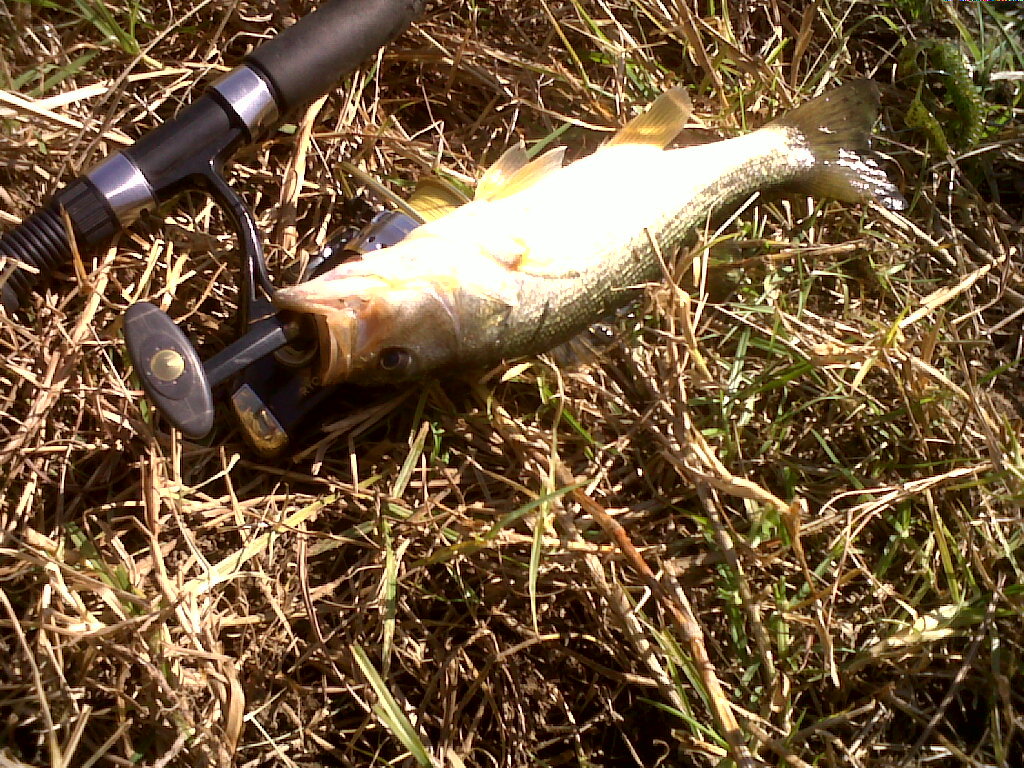
Walked down to the bottom dam on the farm to try my luck fishing for bass. Well guess what? I actually caught four small bass, big enough for the pan though if I was hungry, but they all just posed for a quick pic and returned to their watery world. 


I cheated though, used a bass rod and spinning reel with a big, soft plastic worm on the end. I blame my cheating on my addiction just had to feel a fish on the end of the line. So it wasn't my fault, blame my addiction fishing addiction, no cure for that.


In South Africa there is a common belief that you can only catch fish during the months with an R in them, September through to April, (our spring & summer) except for trout that is. So when you tell people you fish for bass in the winter they look at you as if you have a screw loose, or you are a few sandwiches short of a picnic.


The secret is to fish slow, if you think you are retrieving slowly, reduce you speed still more, and fish right at the bottom. Fish are very lethargic due to the cold but if they see something that they can pick up with little effort, they will. The takes are extremely gentle and you have to give the fish time to really get the lure in it's mouth. If you strike to soon you just pull the lure out of it's mouth. Once hooked they forget their lethargy, these four below put up a good fight trying to entangle them selves in the water weeds.


Click on pictures to enlarge.


First fish.


Next one, I put the long nosed pliers next to the fish to indicate it's size, not big but in spite of it's winter fast still in good condition. As the winter progresses and the water becomes clearer, the fish become a silvery colour and loose most of the olive colouring on their back.


Looks like it's trying to eat the reel, the tail of the lure I used sticking out above the reel.


Last one, all four in about 50 minutes, by now I was chilled to the bone by an icy wind and decided to call it a day.


Fishing with a fly the same principles apply. Weighted fly, eg., woolly bugger, on an intermediate line, let it sink right to the bottom, slow jerky retrieve, with long pauses. It's during the pauses that the bass pick up the fly.


The rod I used is not a bass rod, but my  6' drop shot rod, for surf and rock angling in the sea. The reel is a six bearing, 1:6 ratio, Ryobi (with a drag system that can stop a shark) loaded with 300 meters of 20lbs braid and a six foot 15lb mono filament leader. Bit of overkill for these small fish, but it worked.

Death of the Prince Imperial; Napoleon IV. (part one)

This story starts with the British defeat at Isandhlwana on the 22nd June, 1879. The British central column had crossed the Buffalo river at Rorke's Drift the day before. They stopped at Isandhlwana and camped for the night. Part of the column, under command of General Chelmsford, also overall commander of the British forces invading Zululand, left in the morning to find a camp site for the next days march. The remainder of the force, 1800 men, 950 Europeans and 850 men of the Natal Native Contingent, stayed behind under the command of Bvt. Lt-Col Henry Pullein. 


The British forces were armed with breech loading Martini Henry rifles and the had two cannon of the royal artillery. The Zulus were armed with their short stabbing asegai, the iKlwa, introduced by Shaka, founder of the Zulu nation, some sixty years before.


The iKlwa or Zulu short stabbing spear, the fighting shield was big enough to cover a man's body from head to toe. Each regiment had it's own distinct shield, colours and patterns differed and cattle were especially bred to provide just the right pattern and colour. In battle the Zulu warrior would use the left edge of his shield to pull his opponents shield away from him, thus leaving him open to a thrust from the spear under the left arm into the heart. The name iklwa come from the sound the spear made as it was withdrawn from the opponents body.


Martini Henry breech loading rifle. Rifle magazines were not yet in use so the rifle had to be reloaded after each shot. Companies would line up in two rows, the front row kneeling. A volley would be fired by the front row, and while they were reloading, the standing row would fire. The cartridges used black powder as a charge, which produced a cloud of smoke and fouled the barrel, causing the rifle to kick like a mule, after several shots.
Dabulamanzi kaMpande, half brother to the Zulu King Cetshwayo. Dabulamanzi commanded the Impi which attacked Rorke's Drift the next day. More about this in another post.


The Zulu forces numbered some 20,000 men under the command the inDunas (Princes) Ntshingwayo kaMohole Kozalo, Mavumengwana kaNdlela Ntuli and Dabulamanzi kaMpande, half brother of the Zulu King Cestshwayo, who would take over command if the first two were killed or wounded in battle. 


This was a war which the Zulus neither sought, or knew exactly why they were being invaded. The British government did not want this war either, but had their hand force on the issue by Sir Bartle Frere, Governor of the Cape. The Zulus were only defending home and hearth.


The Zulus attacked in their traditional head and horns formation and overwhelmed the British forces. This was the worst defeat by British forces till then by so called savages. The reasons for this defeat are still being debated by historians to this day and we won't go into them here. The main reason for this defeat was that they underestimated the fighting qualities of the Zulus.


Painting of the battle of Isandhlwana, by Charles Edwin Fripp. The Isandhlwana mountain in the background.


Badge 24th Regiment of Foot, note the Sphinx on the badge. Many visitors have commented on the eerie resemblance Isandhlwana mountain has to a Sphinx. 


Battle of Isandhlwana, from the London Illustrated News.


British forces at Isandlwana numbered about 1800 men, 950 Europeans and 850 natives of the Natal Native contingent. The 24th regiment lost 21 officers and 581 men. Royal artillery lost 68 men, Natal mounted police lost 26 troopers, Natal Carbinereers, still in existence today as a South African regiment, lost 22 men. Several hundred civilians in the employ of the military also died in the battle. By nightfall only 55 Europeans had recrossed the Buffalo River and survived, after a harrowing retreat. About 300 of the Natal Native Contingent survived. 


Isandhlwana today, the white stone cairns indicate mass graves where British troops were buried.


Out of the 20,000 Zulu attackers 2,000 died on the battlefield, how many of the wounded died later is not known. 


Monument to the Zulu dead at Isandhlwana. Zulu King Cetshwayo's comment after hearing of the losses in the battle was, " A spear has been thrust into the belly of the nation." 


After the defeat at Isandhlwana, which left the British nation in a state of shock, there was a call for volunteers and reinforcements to be sent to South Africa. Every young military man wanted to be in on the action and make a name for himself. One of these was the Prince Imperial of France and great nephew of Napoleon Bonaparte.


Napoleon Eugene Bonaparte, Prince Imperial of France, and after his fathers death in exile, thought of by the Bonapartist in France as Napoleon IV.


More about him in the next post.


Pictures in this post are all from Internet sources.
Sources: Washing of the Spears; by Donald R. Morris. & the Internet.